Every April, Britain’s woodlands are transformed by one of spring’s most anticipated spectacles: the beautiful British bluebell (Hyacinthoides non-scripta).
In recognition of Plant Appreciation Day, we’ve teamed up with our plant colleagues at the University’s Department of Plant Sciences, Sainsbury Laboratory and Cambridge University Herbarium to celebrate and explore the science behind this humble flower that is much loved up and down the country.
Is a bluebell really blue?


Did you know that blue is one of nature’s rarest floral colours, occurring in fewer than 10% of flowering plants? This is possibly because blue pigments tend to be more complex molecules. Plants need a complex chemistry toolkit to produce these molecules and to stabilise their blue colour.
The bluebell’s signature hue comes from anthocyanins – a group of flavonoid pigments that can appear red, purple or blue depending on their chemical environment (appearing red in acidic conditions and blue in more alkaline environments). Factors such as pH, light absorption, other flavonoids and metallic ions all influence the final shade we see.
The anthocyanin that gives bluebells their characteristic hue is delphinidin, the primary pigment also responsible for the blue hues of delphiniums, Himalayan blue poppies and violas or pansies.
Delphinidin has three hydroxyl decorations (small oxygen-hyrdrogen units) attached to it, which shifts the colour towards purple and blue. But this is not merely aesthetic, blue and violet tones are highly visible to pollinators, such as bees and bumblebees.
In bluebells, colour also changes over time – younger flowers display a richer blue, fading as they age. This is possibly a signal to pollinators that the flower is past its prime. It could also be that pH regulation in the vacuole is less efficient in older flowers.
There are occasional mutations of the enzymes responsible for anthocyanin pigment production and decoration, which is why we sometimes see plants with pink or white flowers.
A species under pressure


Beneath the beauty of the bluebell lies a more fragile story.
The British bluebell is native across much of the UK, occurring in calcareous and slightly acidic woodland. They start growing early in the year and flower, attract pollinators and produce seed before the tree canopy closes and blocks out sunlight, allowing them to capture maximum light to store as energy in the bulb for next year’s flowers.
In England, bluebells can be indicative of ancient woodlands, which have persisted undisturbed since the 1600s, and developed unique communities of plants, fungi, lichen, insects, birds and mammals.
However, they face several pressures, including habitat loss and hybridisation with non-native relatives.
One long-standing concern is interbreeding with introduced relatives, especially the so-called Spanish bluebell (Hyacinthoides hispanica) thought to have arrived in Britian in the 18th century. This non-native species actually originated from Portugal, not Spain and has interbred with native populations, producing hybrids (Hyacinthoides x massartiana) that are now common in gardens and parks around the UK.
However, recent genetic studies by the Royal Botanic Garden Edinburgh provide some reassurance. While hybrids are now widespread, there is currently no strong evidence of large-scale genetic swamping in natural populations, with only 2% of populations showing evidence of hybridisation. In fact, native British bluebells may have higher fertility than their hybrid counterparts, suggesting they retain a competitive edge in suitable habitats.
How to identify a true British bluebell


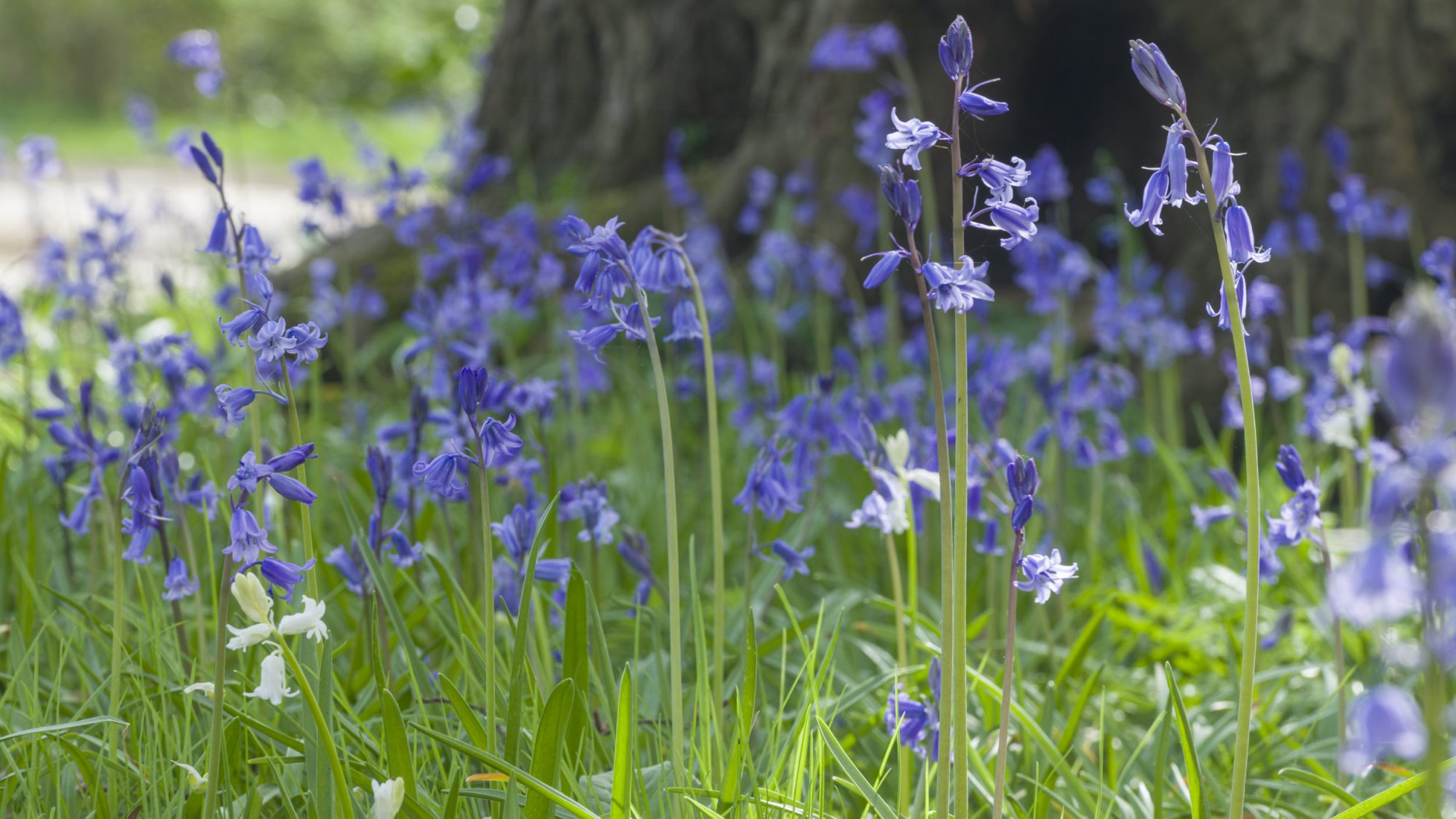
Distinguishing between native, Spanish and hybrid bluebells is not always straightforward. British bluebells typically have a drooping stem with flowers arranged on one side, narrow tubular blooms with strongly recurved tips, and cream-coloured anthers and pollen. They have a sweet perfume.
In contrast, Spanish bluebells are more upright, with flowers arranged around the stem, have blue anthers and usually no perfume. Hybrids often display a mix of characteristics from both British and Spanish bluebells.
British bluebells can be found here in the Botanic Garden dotted along the boundaries and long grass areas. There are not dense plantings and are variable due to hybridisation.
Not all bluebell woods are publicly accessible, so it’s always wise to check if access is permitted before entering. It is illegal to pick them without the landowner’s permission. Under the Wildlife and Countryside Act 1981, digging up bulbs can result in a fine of £5,000 per bulb
What’s in the name?


The British bluebell – or Hyacinthoides non-scripta – has been known by many different names over time.
Historically, taxonomists classified plants by visible features, but genetic analysis has revealed that many supposedly distinct species were in fact the same plant under different names. These species were brought together under one ‘correct’ name – in this case, Hyacinthoides non-scripta – and the other names become known as synonyms (alternative scientific names that refer to the same species).
Many of these name changes are captured by herbarium specimens, dried plants that can be hundreds of years old, many of which are still annotated with their historic names. One Cambridge Herbarium specimen captures eight of the historic names used for this species, and another – originally collected in 1932 – is annotated with three different names, the most recent being the correct Hyacinthoides non-scripta.
Herbarium specimens provide a valuable resource that record the locations and flowering time of bluebells and other plants over long periods of time, providing historic records for tracking plant phenology and response to climate change.
Facts you (probably) never knew about bluebells


- They don’t have petals: The six violet-blue petals are called tepals because the three outer and inner parts are similar and not clearly differentiated into petals and sepals
- Invasive weed: It has naturalised in other parts of Europe and parts of North America, where it has become invasive
- Toxic plant: It is harmful to animals and humans – its sap can cause dermatitis – but the seeds are eaten by mice and voles
- Fit for a queen: A vital early nectar source for bumblebee queens, although some ‘cheat’ by making holes at the base of the flower to take the nectar and bypass pollination
- Historic uses (despite toxicity): There are limited records, but it was used as a styptic, to treat snake bites and leprosy, and bulb extracts supposedly once made glue for bookbinding
- Unexpected chemistry: It is being studied for potential cancer and parasite treatments and extraction of oil from the seeds
Thank you to scientists and horticulturists from Cambridge University Botanic Garden, the Department of Plant Sciences, Cambridge University Herbarium and Sainsbury Laboratory for the information shared in this article.