The sight of spring blossom is a heartwarming moment in the horticultural year, and heralds lengthening, warmer days.
Such is the impact of this spectacle that it is hard not to be moved by the sight of clouds of delicate blooms brightening our gardens, streets and hedgerows.
The term blossom is usually associated with the spring-flowering members of the rose family, such as the cherries and apples. For me though the term is much more wide-ranging, encompassing a host of spring-flowering trees and shrubs, whose blooms brighten our landscapes from March through to May. Among these are the Magnolias, whose flowers punctuate early spring days.
There then follows a succession of blooms, including the cherries (Prunus), apples and crab apples (Malus), hawthorn (Crataegus) and viburnums, such as the wayfaring tree (Viburnum lantana) and guelder rose (V. opulus). And while they may be diverse in their form and detail, in succession they present a delectable palette of sumptuous blooms.


The tradition of Hanami
In Japan cherry blossom season has its own celebration, sakura, which varies according to location and flowering time, starting in Okinawa in January, and finishing in Hokkaido in April with late-season blooms. Such is the fervour for cherry blossom in Japan that generations adopt the centuries old tradition of hanami, in which families celebrate the arrival of spring by viewing blossom while indulging in family picnics and parties.
While here in the UK we may not go to such lengths to celebrate this spectacle, and are perhaps more open-minded in our appreciation of a diversity of blossoms, a survey for the National Trust reported that 94% of people reported feeling happy at the sight of spring blossom – such is the power of plants.


Blossom for pollinators
But it is also easy for human admirers to overlook that the production of spring blossom isn’t just for our benefit but serves to attract pollinators who visit the flowers in exchange for nectar. And once pollination has occurred, blossom trees, whether cherry, hawthorn, sloe, apple or crab apple, continue to support the wider ecosystem in providing food and shelter for a range of mammals, birds and insects.
The native sloe, or blackthorn (Prunus spinosa), for example, not only puts on a show of white flowers in spring, but also provides a source of food for birds (as well as a flavouring for gin for humans), but is also estimated to support over 100 insect species, the majority of which are butterflies and moths.


Blossom in abundance in the Botanic Garden
Here in the Botanic Garden blossom season for me starts with the Magnolias, whose waxy, goblet-shaped flowers emerge before the leaves, and whose generous blooms brighten the darkest of early spring days. Perhaps the most widely admired of these is Magnolia x soulangeana, whose pink-tinged blooms adorn many domestic gardens, while M. stellata, with its delicate star-shaped flowers, and the large, deep pink M. sprengeri ‘Diva’ are less widely grown, but equally rewarding in their flower. There then comes a flurry of flamboyant flowering, starting with the familiar lilacs (Syringa species) whose panicles bear many scented, tubular flowers.
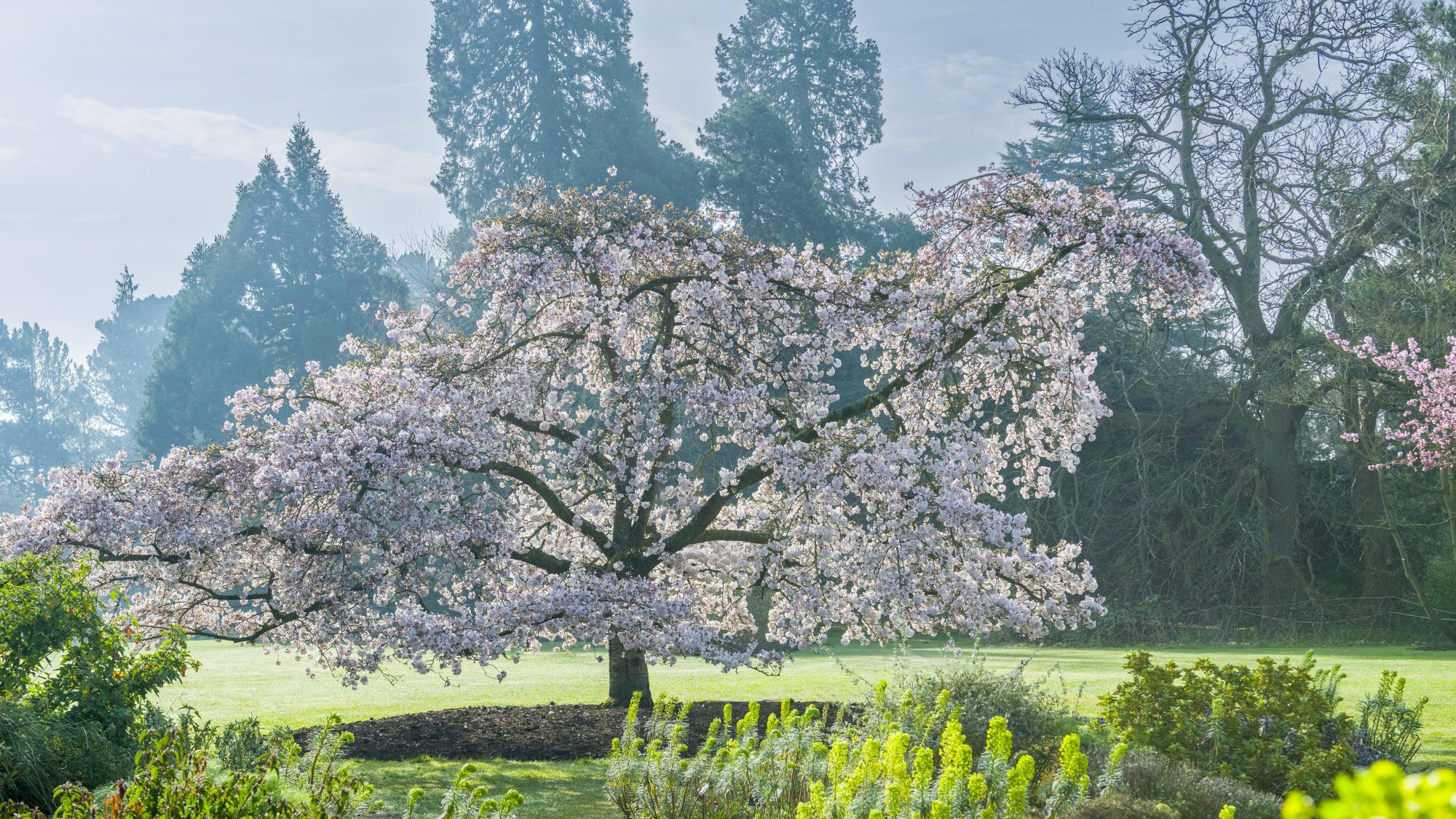
Of course though, the stars of the season are perhaps the rose relatives whose flowering starts with the delicate Japanese apricot (Prunus mume) in February. There then follows a succession of florific crowd pleasers, such as the white wild cherry, Prunus avium, and its double form ‘Plena’, and the suitably orientally named ‘Shogetsu’ and ‘Shirofugen’ whose double pink flowers are widely admired. The great white cherry, Prunus ‘Tai Haku’ whose low, broad form is bedecked with large, single white flowers prides a floral feast. And taking pride of place here on the Botanic Garden’s Main Lawn is the Yoshino cherry (Prunus x yedoensis). It bears single, bowl-shaped, almond scented , pink-flushed flowers which create a seasonal highlight – a must-see spring highlight!


Of course, such flamboyance may not be to everyone’s taste. For those with a more discerning palate, the early-flowering cherry ‘Kojo-no-mai’ carries delicate white flowers in March to April, and reaches only 2.5m in height, making it an excellent choice for a planter. And flowering later in the season is the oriental crab apple Malus transitoria, whose star-shaped blooms cover the entire canopy and annually, which I admit I always want to dive into such is the charm of this tree.
Rounding off the season are a host of natives, including the hawthorn, or may flower, (Crataegus monogyna), whose flat-topped clusters of white flowers adorn many hedgerows, the sloe’; the bird cherry (Prunus padus) with its delicate, almond-scented racemes of flowers; and the guelder rose (Viburnum opulus), which bears pompom-like clusters of white or green-tinged flowers. All perhaps much more subtle in their flowering than their more ornamental counterparts, but no less valuable in our landscapes.
With such an array of blossom-bearing trees and shrubs adorning our gardens, streets and hedgerows, there are plenty to admire. Whether though you have one particular favourite, or are less discerning in your tastes, it’s worth taking a moment to savour the flamboyance of our spring blossom, and perhaps even marking this spectacle with your own hanami celebration.


Gardening jobs for March
- Finish cutting back herbaceous perennials and ornamental grasses left over winter to provide interest and shelter of insects.
- Tidy borders and vegetable beds, removing established and newly-emerging weeds.
- Plant summer-flowering bulbs such as lilies, alliums and gladioli.
- Finish pruning roses, and shrubs with coloured winter stems such as dogwoods (Cornus).
- Start mowing the lawn, but set the blade higher than you would in summer.
- Sow tomatoes and chillies.