

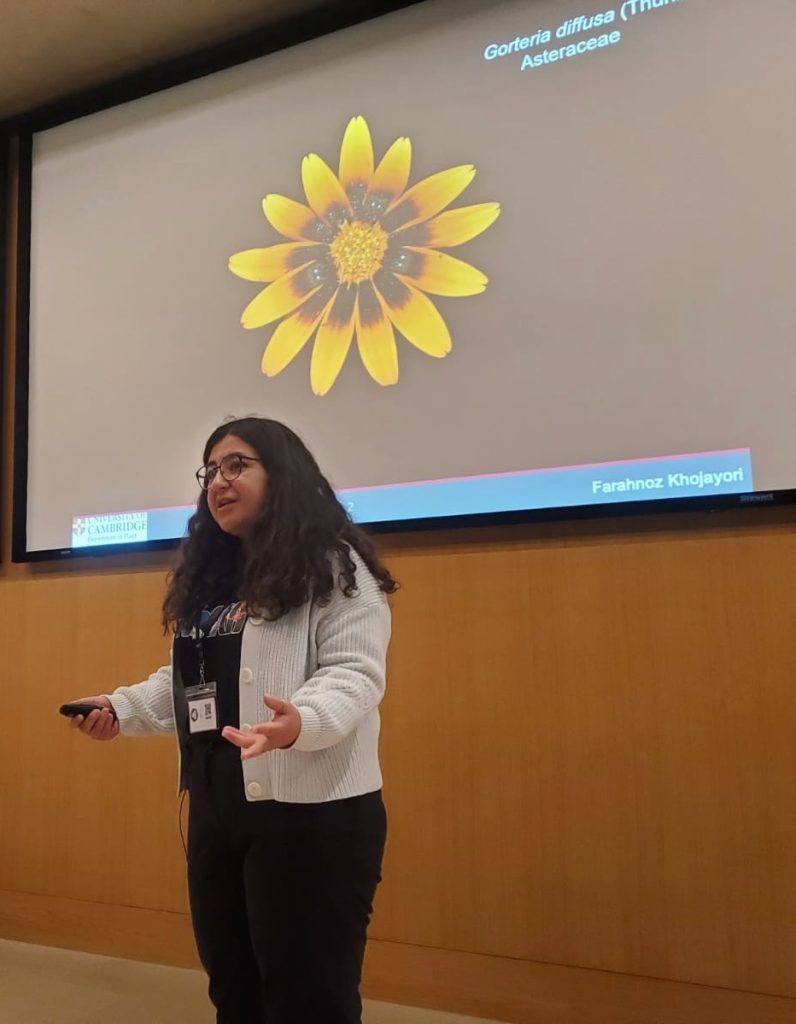
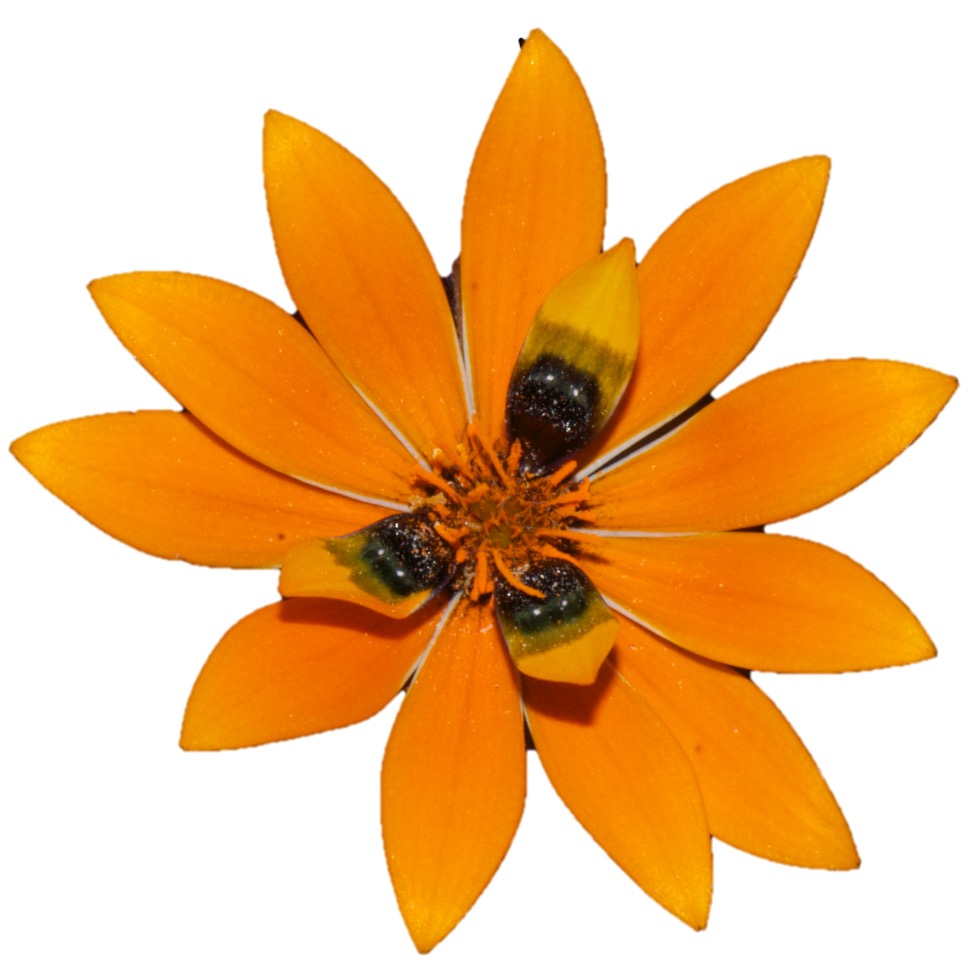
We’re delighted to share that the inaugural Agnes Arber Prize in Comparative Plant Biology has been awarded to Farahnoz Khojayori from Cambridge University’s Department of Plant Sciences. Her research reveals how the South African daisy Gorteria diffusa evolved petal markings that mimic the form and colour of its pollinator, the bee-fly.
This new prize was established to recognise the work of the pioneering Cambridge plant biologist, Agnes Arber, the first woman botanist to be elected a Fellow of the Royal Society.
Arber studied for degrees at University College London and then at the University of Cambridge, Newnham College. At this time (1899), women at Cambridge were not full members of the University, had restricted access to laboratory teaching and were not awarded Cambridge degrees. She did ‘much of her most important work’ at her Cambridge lab, after becoming a widowed single parent in 1918.

“Arber’s legacy is not only scientific – in her important anatomical and morphological work – but also in the spirit with which she worked. Her tenacity and curiosity are inspirational, and I hope will inspire future early career researchers as they embark on their careers in science. Congratulations to Farahnoz!”
The Botanic Garden’s Director, Professor Beverley Glover, explains the significance of the Agnes Arber Prize in Comparative Plant Biology:
“We established the Agnes Arber Prize with funding from the Cambridge University Botanic Garden Research Fund, to honour Agnes Arber’s fantastic work in the field of comparative plant science – the comparative study of different plant species which enables better insight into how plants develop and evolve – and to encourage early career researchers to take a comparative approach using the Botanic Garden’s living collection.
The prize is for comparative plant science research, which means that researchers need to access a diversity of plants for the comparative work. The Botanic Garden here supports an unparallelled living collection of 8,000 species from around the world, supporting exactly this kind of research approach.”
Beverley continues:
“Our hope is that this new prize will raise the profile of the Garden’s role in supporting researchers and encourage other researchers to think about how the collection we curate can help address the fundamental research questions facing the world.”
“Arber’s legacy is not only scientific – in her important anatomical and morphological work – but also in the spirit with which she worked. Her tenacity and curiosity are inspirational, and I hope will inspire future early career researchers as they embark on their careers in science. Congratulations to Farahnoz!”
By comparing its flower structures and genes with those of related species, I uncovered how this plant developed the special traits that make its clever deception possible.
Here Farahnoz, from the University’s Department of Plant Sciences, tells us more about her prize-winning research:
Congratulations on being awarded the prize for the best PhD thesis. Please can you share with us what your PhD research is about?
Thank you for the honour. This work involved investigating how a South African daisy, Gorteria diffusa, has evolved unique colour spots on their flowers that mimic the shape and colour of their main pollinator, a bee-fly. The flowers use this clever trick to attract the male flies, which try to mate with them and, in doing so, spread the pollen to other flowers. I explored how this feature has evolved, including the kinds of pigments, cells, structures, genes, and developmental processes that might be involved.
Can you explain in more detail what comparative plant biology is, why it’s important and how your research fits within this?
Comparative biology is a foundational science found throughout modern history in the works of Theophrastus (on medicinal plants), Ibn Sina (Avicenna; on human anatomy), Payer (on flowering plants) and most notably Darwin (on animals and plants) and Wallace (on animals). Simply, comparative biology is the careful study of organism(s) and subsequent comparison with other organism(s) to understand relationships between species and reconstruct their evolutionary history. For example, Charles Darwin’s famous work comparing the sizes and shapes of beaks of the Galápagos finches, to understand how each was related and how they had adapted to a specific type of food.
Today comparative biology extends beyond the superficial comparisons of anatomy to studies at the molecular level (such as DNA and proteins), at the organism level and at the macro levels (such as an ecological niche an organism occupies).
In plant science, comparative biology has been used to study the evolution of key traits including leaves, roots, flowers and fruit through comparison with both other living and extinct species, to build an understanding of how those traits have evolved across space and time.
In my PhD, I used comparative biology to explore how a small South African daisy evolved to mimic its pollinator. By comparing its flower structures and genes with those of related species, I uncovered how this plant developed the special traits that make its clever deception possible.

What does winning the inaugural Agnes Arber Prize mean to you?
I am immeasurably honoured to receive the inaugural Agnes Arber Prize in Comparative Biology. Agnes Arber was a pioneer and champion for the advancement of botany and women, at a time when women were not afforded equal rights to access or study. After Linnaeus’s publication Systema Naturae (first published in 1735), which classified plants based on descriptions of the sexual parts of flowers, botany was considered too controversial a topic for women to read, let alone study in British society.
Arber’s determination, intellectual rigor and enduring contributions to plant science continue to serve as an inspiration. This award is especially meaningful to me as it recognizes the importance of comparative approaches in understanding plant evolution, while also celebrating the values of curiosity, determination, and inclusivity that Arber embodied.
Have you been inspired in any way by Agnes Arber’s story? If so, how?
Absolutely. I first learned of Agnes Arber while preparing for the 300th Anniversary of the first Professor of Botany at the University of Cambridge. Her perseverance and extensive contributions to plant science, achieved despite the societal and institutional limitations of her time, are profoundly inspiring. Her legacy continues to serve as a model of determination and intellectual excellence for researchers today.
What drew you to comparative plant biology, and what excites you most about the field today?
During my undergraduate studies, my favourite classes were genetics and comparative vertebrate anatomy (CVA). Genetics appealed to me because it was logical and mathematical, while CVA allowed me to see evolution in action – for example, how cartilage in a shark’s gills evolved into the bones of a salamander or even structures in the human ear. It was fascinating to trace evolutionary changes across vast spans of time and to piece together the story of how modern organisms came to be.
My path into plant biology began when I took a course on plant development with Dr. Wenheng Zhang (Associate Professor, Virginia Commonwealth University). It was a revelation! Unlike the relatively linear development I had studied in animals, plants displayed remarkable plasticity – the ability to adapt and modify their growth in response to their environment. That flexibility, and the opportunity to explore evolution and development in such a dynamic system, is what drew me to comparative plant biology and continues to excite me today.

How do you see your research contributing to plant science in the long term?
There is still a lot of work to be done towards our understanding of how sexual deception has evolved in Gorteria diffusa. My work is but one part of that larger body of discovery that will help shed light on how plant species evolve and how new cell types can emerge in plants. These invaluable insights can advance preservation of biodiversity, improve agricultural output to meet global demands, and develop technological advances for complex biological systems.
What are your next steps now that your PhD is complete?
Now, I am pursuing a post-doctoral fellowship to continue studying the evolution and development of plants. It is the most fascinating and interdisciplinary topic as it covers everything from small molecules to larger ecosystems and compares them across systems to reconstruct a story on the origins of life.
What advice would you give to aspiring botanists or early-career researchers?
The best advice for any young researcher can be found in the model set by Agnes Arber -to be curious and tenacious in your pursuit of knowledge. Furthermore, find a good mentor, who can also be your friend and safe person to challenge you and give you the space to study extensively as Ethel Sargent did for Arber and as my mentors have for me. And from that safe point you can then pursue your passions ardently against any odds or restrictions.
Warmest congratulations to Farahnoz Khojayori, the winner of the 2025 Agnes Arber Prize in Comparative Plant Biology. Through this annual prize, we look forward to supporting the next generation of pioneering botanists, following in the footsteps of Agnes Arber.


