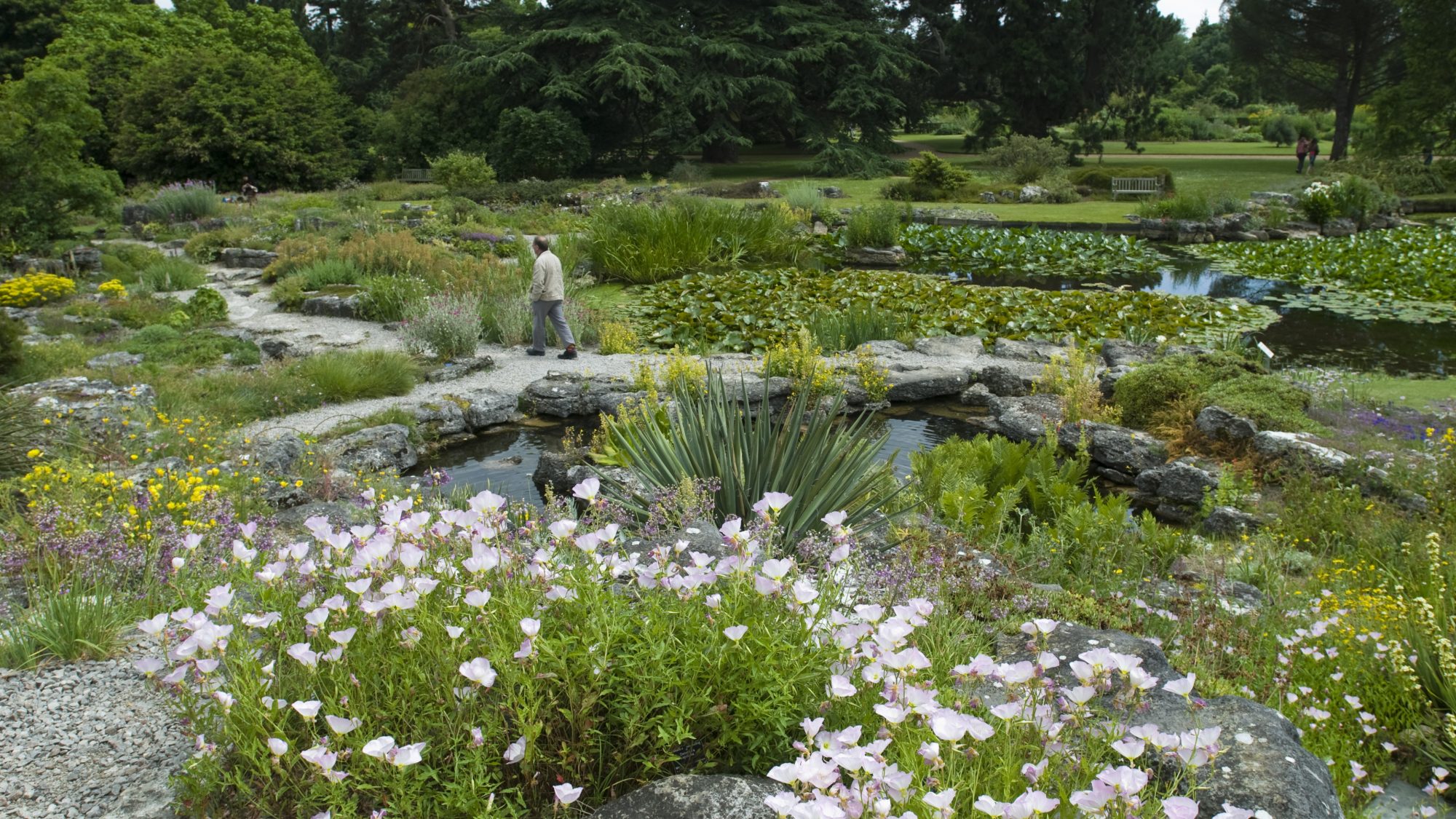
The Rock Garden at Cambridge University Botanic Garden is one of our key features, sitting beside the Lake and displaying a host of alpine plants from across the globe such as Primula marginata (silver-edged primrose), Tulipa montana, (mountain tulip), Aethionema grandiflorum (Persian stonecress), Pulsatilla rubra (red pasque flower) and Sisyrinchium marcocarpum.
Of course, in our mountain-free region of Cambridgeshire, the Rock Garden is man-made, and was constructed in the 1950s using 500 tons of carboniferous limestone from Milnethorpe in Cumbria. Covering approximately one acre, it was developed on an open site under the watchful eye of the then Superintendent, Bob Younger, who directed the construction to include planting pockets, crevices and screes to provide full sun and shade for a diversity of species.
Today the Rock Garden is an established historical feature, where a range of beautiful jewel-like bulbous, herbaceous perennial and woody plants grow. For me it is hard to equate the delicate appearance of these alpine gems with the tough, inhospitable conditions from which many of them originate.
Rock gardens across the UK


Across the country there are several well-known rock gardens to admire, each with their own distinct character. Perhaps the most iconic is the rock garden at Royal Horticultural Society (RHS) Wisley, where sandstone blocks are embedded into a steep, north-facing slope. The sandstone rock garden at Royal Botanic Garden (RBG) Kew has a wide path meandering through large boulders amongst rock work and alpines from six mountainous regions of the world, while at RBG Edinburgh the rock garden contains approximately 5000 alpine species, which sit in the naturally undulating landscape. More recently RHS Harlow Carr has installed a limestone rock garden adjacent to its alpine house. All include water features, which add to the charm of these features, but more importantly, all have good drainage and an open position necessary for alpine plants to flourish.
While the heyday of the construction of rock gardens maybe a thing of the past due to financial and environmental concerns, there is plenty of scope to include alpines in your own garden.
What are true alpine plants?


True alpine plants grow above the tree line in inhospitable mountainous regions at altitudes up to 4000m above sea level. Here they are covered by an insulating layer of snow in winter, but they also endure low temperatures; limited water; strong winds; intense light; poor, rocky soils and low nutrient levels. In response to these conditions they have compact habits, small leaves, extensive root systems, and a short growing season in which to produce flower and seed. Today many of these ‘high alpines’ are under threat from climate change, which is affecting snowfall and timing of snow melt, and consequently the fragile ecosystems in which they grow.
In gardening terms though the phrase alpine also extends to small plants from other habitats which enjoy the same growing conditions of good drainage and ventilation.
“One of the great benefits of these charming plants is that you can squeeze many into a small space, making them ideal for even the most compact garden.”
Alpines for every garden - how to create your own rock garden


Whether a high alpine or a small plant from a lower altitude, all are suitable for cultivation in our climate, whether it be individually in pots, or a medley of plants in a window box, trough, raised bed, or a rock garden. And of course, one of the great benefits of these charming plants is that you can squeeze many into a small space, making them ideal for even the most compact garden.
There are a few guiding principles you should follow if you’re venturing into alpine cultivation. If you’re using a container for growing alpines position it in an open site to encourage air flow, put a layer of crocks (broken pots) or grit in the bottom of your container and add plenty of grit to your compost to aid drainage, and add a top dressing of grit on the surface of the compost to ensure that plants don’t rot sitting on wet compost. If though your alpine ambitions are grander and you wish to build a rock garden you should:
- Ensure your chosen site is weed free before you start.
- Add a base layer of rubble, stone and shingle and top this with a permeable membrane to prevent soil loss into the base layer.
- Add peat free compost with at least 30% extra grit.
- Use a mixture of rock sizes, using larger rocks as feature keystones.
- Embed the rocks so that at least one-third of them is buried in the soil and try to make them look as natural as possible.
- Plant up with young plants (these will establish more quickly).
- Top dress with gravel or grit.
Spring alpine highlights


At this time of year many garden centres have a range of alpines including Narcissus bulbocodium (hoop petticoat daffodil), Sempervivum tectorum (house leek), Dianthus alpinus (alpine pink), Saxifraga ‘Peter Pan’ and even our native Pulsatilla vulgaris (pasque flower) to entice even the least experienced gardeners to give these delightful spring bloomers a go. If you are looking for a wider range of alpines for your patch there are several specialist alpine nurseries offering a diverse selection of plants from varieties and cultivars of Cyclamen coum to plants for the dedicated alpine enthusiast such as the South American Benthamiella patagonica, which requires alpine house cultivation. If you do develop a penchant for alpines you might consider joining the Alpine Garden Society which has numerous local groups and alpine shows throughout the country, and whose members hold a wealth of expert knowledge to share with like-minded gardeners.
Whether though you’re merely dabbling with a few of these exquisite spring plants, or developing an extensive rock garden and alpine collection, they will grow well in the East Anglian climate, are small in stature so can be squeezed into the smallest garden, and are sure to add charm to your garden not only in spring, but throughout the year.
Gardening jobs for April
- Give your lawn a cut if you’ve not already done so, remembering to lift the blade height for the first few cuts of the season.
- Weed, weed and weed – time spent weeding now will save you time later in the year.
- Stake herbaceous perennials to stop them falling over neighbouring plants and paths later in the year.
- Sow hardy annuals such as love-in-a-mist and sunflowers, and continue sowing vegetables such as beetroot and lettuce to give a succession of crops.
- Plant second-early and maincrop potatoes.