Back to the page
  • Welcome
  • Visit us
    • Visit us
    • Opening times & information
    • Visiting – travel, dogs, toilets, etc.
    • Ticket Prices
    • Pre-book tickets
    • Garden map
    • Group Visits
    • Tours
    • Press and photography
    • The Garden Café
    • The Garden Shop
  • Accessibility
  • What’s on
  • The Garden
    • The Garden
    • About the Garden
    • Horticultural Collections
    • Understanding Plant Labels
    • History of the Garden
    • Wildlife
    • Plant picks of the week
  • Learning
    • Learning
    • Schools
    • Colleges and Universities
    • Short Courses
    • Family Activities
    • Communities
    • Science on Sundays
    • Trails for Adults
    • Certificate in Botanical Horticulture
  • Science
    • Science
    • Our Science Staff
    • Our Staff Publications
    • Your Science
    • Supporting Your Research
    • Phenology Project
  • Collections
    • Collections
    • Living Collections
    • Seed Bank
    • Herbarium
    • Cory Library
    • Archives
    • Living Collections Portal
    • Botanic Dyes
  • News
  • Support Us
  • Friends
    • Friends
    • Join the Friends
    • Friends’ Events
    • Corporate Support and Corporate Friends
    • Gift Memberships
  • Talking Plants
    • Talking Plants
    • Talking Plants – Frequently Asked Questions (FAQs)
Donate
Cambridge University Botanic Garden
menu

Today's Opening Times:
10:00am - 5:00pm

  • News
  • Support Us
  • Contact Us
  • Donate
  • Home
  • Visit us
    • Ticket Prices
    • Opening times & Information
    • Visiting – travel, dogs, toilets, etc.
    • Garden Map
    • Group Visits
    • Tours
    • Pre-book tickets
    • Press & Photography
    • The Garden Shop
    • The Garden Café
    • Accessibility
    • Virtual Visits
  • What’s on
  • The Garden
    • About the Garden
    • Horticultural Collections
    • Understanding Plant Labels
    • History of the Garden
    • Wildlife
    • Plant picks of the week
  • Learning
    • Schools
    • Colleges and Universities
    • Short Courses
    • Family Activities
    • Communities
    • Science on Sundays
    • Trails for Adults
    • Certificate in Botanical Horticulture
  • Science
    • Our Science Staff
    • Our Staff Publications
    • Your Science
    • Supported Publications
    • Supporting Your Research
    • Phenology Project
  • Collections
    • Living Collections
    • Herbarium
    • Seed Bank
    • Cory Library
    • Archives
    • Collecting Expeditions
    • National Plant Collections ®
    • Living Collections Portal
    • Botanic Dyes
  • Friends
    • Join the Friends
    • Gift Memberships
    • Friends’ Events
    • Corporate Support and Corporate Friends
  • Talking Plants
    • Talking Plants – Frequently Asked Questions (FAQs)
  • Open search panel
Close search panel
Back to listing
Home News Garden news Precision pollination brings new hope for a rare orchid
Share Created with Sketch.
  • Email Share this with Email
  • Facebook Share this with Facebook
  • Twitter Share this with Twitter
  • Pinterest Share this with Pinterest
  • WhatsApp Share this with WhatsApp
  • Google + Share this with Google plus

Precision pollination brings new hope for a rare orchid

Challenging and meticulous work has paid off, delivering a promising plant conservation success at Cambridge University Botanic Garden.

09 January 2026

After some extraordinarily careful hand-pollination last summer, the Glasshouse team has successfully produced seed from one of the world’s rarest cultivated orchids.

Several seed pods are now developing on Polystachia tsaratananae – a little-known species that CUBG is believed to be the only botanic garden in the UK, and possibly the world, currently growing. According to Botanic Gardens Conservation International (BGCI) records, no other garden worldwide is cultivating this orchid.

That makes this success more than just good news – it’s a significant step forward for the species’ conservation.

With seed pods now forming, the team has begun sharing this rare plant with the wider botanic garden community. Two green seed pods have already been delivered to Royal Botanic Gardens (RBG) Kew, with plans to distribute material more widely to support research, conservation and long-term safeguarding.

“No single garden can save a species alone,” says Glasshouse Team Leader Luigi Leoni. “Pollinating this orchid was a tiny, delicate act – but sharing it across the botanic garden network is what really gives it a future.”

Close-up of a vibrant pink orchid with multiple blossoms, set against a dark background.
Polystachya tsaratananae. Credit: Howard Rice. Click for information
A person's hand delicately holding a stem of small purple flowers against a dark background, using tweezers to extract pollen from the plant.
Careful extraction from Polystachya tsaratananae. Credit: Howard Rice. Click for information
A person holds small green seed pods in their open palm.
The two green seed pods take to Royal Botanic Garden Kew. Click for information

The pollination took place in July 2025 and was the first time the CUBG team had attempted to pollinate this particular species. While the team is well-versed in hand-pollinating orchids – from Vanilla planifolia to several Cymbidium species – P. tsaratananae raised the stakes.

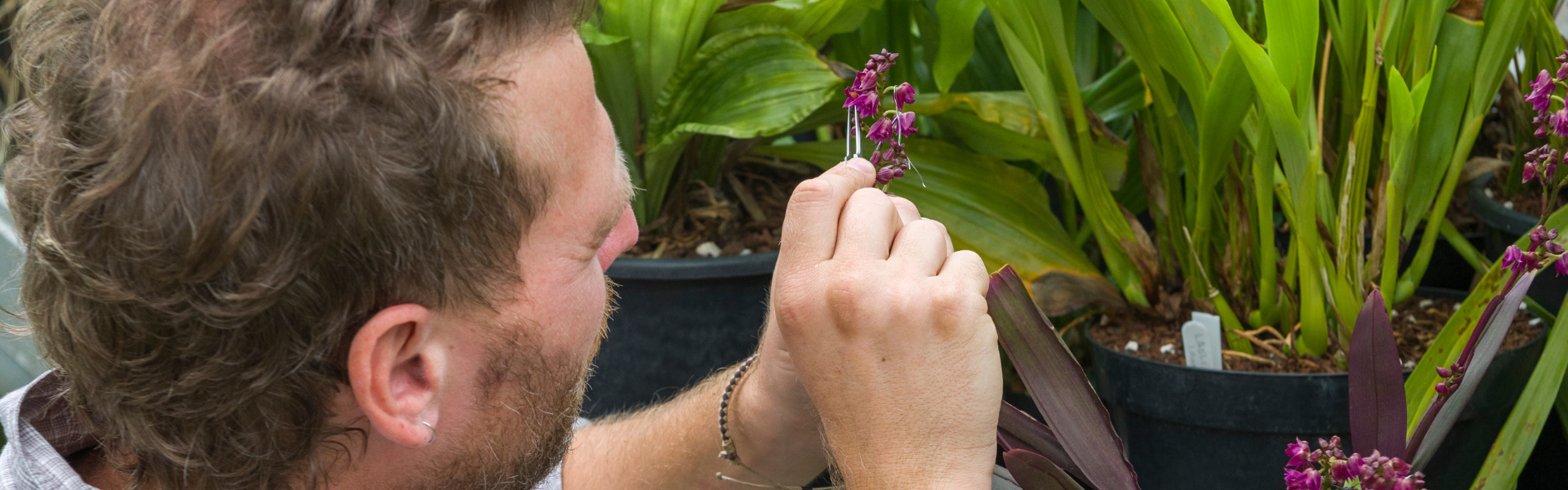
Its flowers are so small that simply finding the reproductive structures is a challenge in itself. Using fine tweezers, the team carefully removed the anther cap to expose the pollinia – compact packets of pollen designed for insect transport – before transferring them to the sticky stigmatic surface inside the flower’s column. The margin for error was tiny.

“The technique itself was familiar,” Luigi explains, “but the practicality was far more demanding. Even the slightest tremble of the hand could send everything off course.”

As soon as the first flowers appeared, pollination attempts began – and quickly became a full team effort. Staff, trainees and even a visiting work experience student from RHS Bridgewater took part. With a large camera zoomed in on every movement, the atmosphere was intense, occasionally nerve-wracking, and often entertaining, complete with shaky hands, dropped tools and plenty of good-natured commentary.

The patience paid off. Seventeen seed pods are now developing on the plant – an exceptional result for such a rare species. In December, the first two green seed pods made their journey to RBG Kew, marking the next chapter in this orchid’s story.

A person examining plants in a greenhouse, closely inspecting a potted plant with pink flowers.
Glasshouse Team Leader, Luigi, carefully hand-pollinates Polystachia tsaratananae. Click for information
A person's hand delicately holding a stem of small purple flowers against a dark background, using tweezers to extract pollen from the plant.
Careful hand-pollination of Polystachia tsaratananae. Click for information
Close-up of a hand holding tweezers, with small yellow and purple plant fragments on the palm.
Using tweezers, the team removed the anther cap and pollinia. Click for information
Close-up of a hand holding tweezers, with small yellow and purple plant fragments on the palm.
Using tweezers, the team removed the anther cap and pollinia. Click for information
Close-up of a hand holding tweezers, with small yellow and purple plant fragments on the palm.
Using tweezers, the team removed the anther cap and pollinia. Click for information

Orchid seed pods can take many months to mature, but seeds can be sown earlier using a technique known as green pod sowing. As CUBG does not currently have facilities for sterile orchid seed sowing, sharing material with Kew allows propagation to begin while plans for wider distribution take shape.

The Cambridge plants themselves have travelled a long way to get here. They were grown from seed germinated at Kew following a collection made in northern Madagascar in the late 1990s. The seeds were collected in the Anjanaharibe area, near a village that had recently burned down. The mother plant was found at the base of a burnt tree beside a newly laid road.

Two plants arrived at CUBG in 2001 and were accessioned in 2002, later potted together into a single specimen. In that context, it felt particularly fitting that Kew should receive the first seed pods from the next generation.

Cultivating Polystachia tsaratananae matters because it is so rare in cultivation. While the species has not yet been assessed by the International Union for Conservation of Nature (IUCN) Red List, a 2024 study using artificial intelligence to predict extinction risk classified it as threatened – making this careful, collaborative work all the more important.
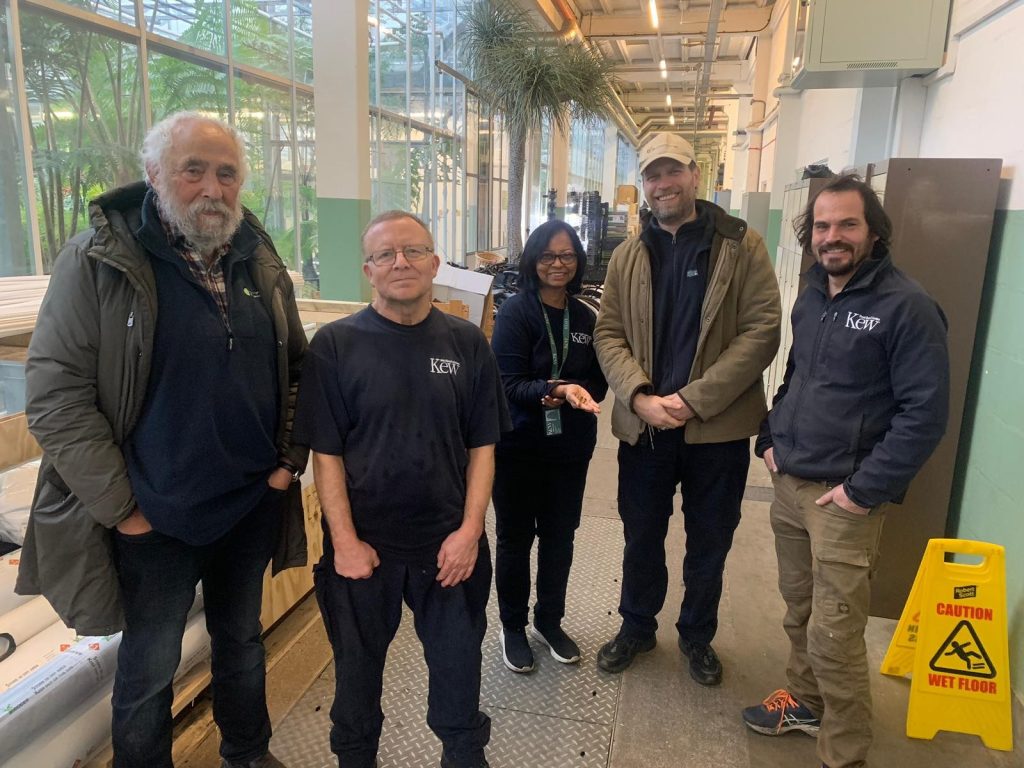
Five people standing in a greenhouse at Kew Gardens, smiling at the camera.
Members of CUBG's Glasshouse Team with staff at Royal Botanic Garden Kew. Click for information
University of Cambridge Museums and Botanic Garden

Social

  • Follow us on YouTube
  • Follow us on Twitter
  • Follow us on Instagram
  • Follow us on Facebook
  • Follow us on Threads
  • Follow us on LinkedIn

© 2026 Cambridge University Botanic Garden

  • Privacy policy
  • Contact us