
What would you ask a plant that was thought to be extinct until 1980, or one whose ancestors were growing even before bees, flowers and dinosaurs?
Get your questions ready as our plants have some fascinating stories to tell and they are ready to chat!
From 11 February to 12 April, a new interactive, experimental exhibition is coming to Cambridge University Botanic Garden (CUBG). Talking Plants lets visitors chat with 20 rare and wonderful specimens in the Garden’s iconic Glasshouse Range. By scanning a QR code with a smartphone, visitors can ask questions and receive answers that blend horticultural insight with personal stories from the plants. The two-way conversation can be voice or text-based.
Talking Plants is designed to be playful and welcoming for all ages, while drawing directly on the vast expertise of the Garden’s staff and researchers. Rather than presenting facts, each plant has its own voice and personality – shaped by its evolution, ecology, even quirks. There’s a bold and sassy Jade vine (Strongylodon macrobotrys) that swings from the ceiling, a blunt and dramatic Titan arum (Amorphophallus titanium) that likes to show off, and a supportive and caring Ant plant (Myrmecodia tuberosa),
As well as conversing, the plants will be able to tell a joke, test visitors with trivia and even meditate with visitors. There will also be suggested prompt questions to help the conversation flow.
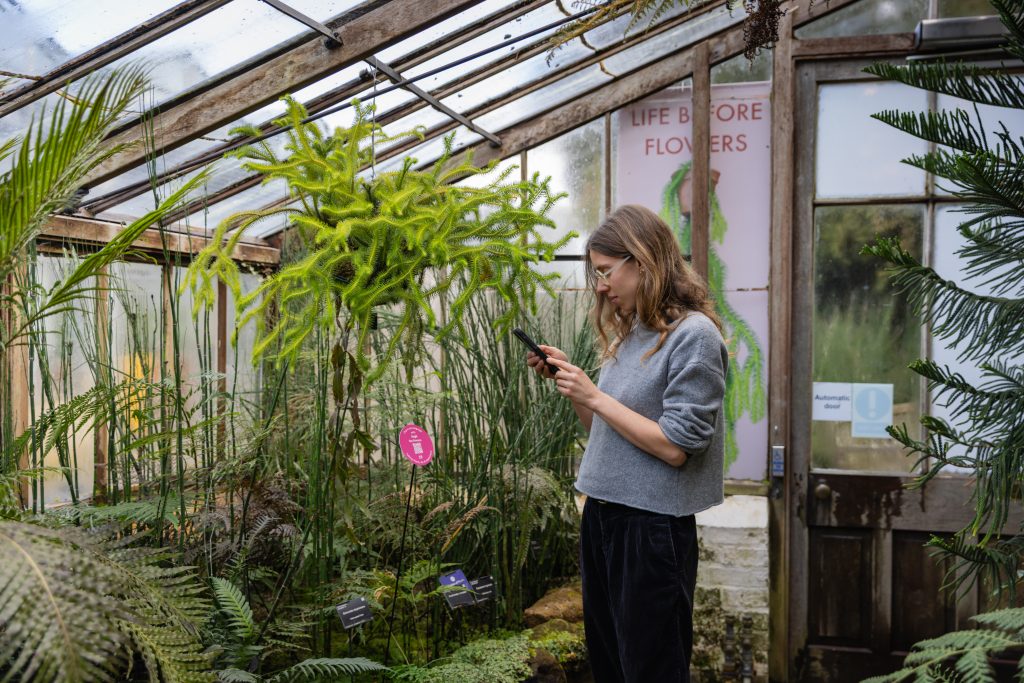
Shaped by our staff’s knowledge, the conversations give visitors a relaxed, engaging way to discover plant stories at their own pace. Talking Plants is designed to spark questions, encourage exploration and invite moments of surprise – adding an extra layer to the experience, rather than replace human expertise.
CUBG is the first botanic garden in the world to try this approach, building on earlier experiments at the University Museum of Zoology, Cambridge (Exploring AI at the Museum of Zoology – Cambridge University Museums). For the team here at CUBG, Talking Plants is also a chance to explore how they might help people connect more deeply with plants, biodiversity and the Garden’s Living Collections.
Professor Sam Brockington, Curator of Cambridge University Botanic Garden and Professor of Evolution at Cambridge University, says:
“Plants shape our world in profound ways. Like all living organisms, they must acquire resources, cope with extreme conditions, reproduce and ensure the survival of their next generation. Plants do all of this while remaining rooted in place, and have evolved a vast range of sophisticated solutions, even if they are often overlooked or taken for granted.
“Talking Plants is a playful way to change that, using artificial intelligence to help visitors engage with the biology, ecology and culture of the plants in our Living Collections. It is not about replacing our human expertise, but about finding new ways to stimulate learning and wonder about the plant kingdom. We hope it will give us new insight into how to best engage people with important messages about biodiversity loss and environmental change, which will influence all our learning programmes.”
” It is not about replacing our human expertise, but about finding new ways to stimulate learning and wonder about the plant kingdom. We hope it will give us new insight into how to best engage people with important messages about biodiversity loss and environmental change, which will influence all our learning programmes.”
Developed in collaboration with Nature Perspectives Nature Perspectives | AI for Nature– a conservation organisation developing AI models, backed by science, to enable people to have meaningful conversations with the natural world – the exhibition is both a visitor experience and a live experiment, inviting people to ask questions and follow their curiosity, discovering more about each plant’s habitat, life cycle, ecological role and cultural significance.
Gal Zanir, Co-Founder & CEO of Nature Perspectives, says:
“Much of how we engage with nature today is one-way: we observe it, learn about it and admire it from a distance. At Nature Perspectives, we enable a shift toward conservation – encouraging attentiveness, imagination and new ways of relating to the living world. We’re shifting from learning about nature to learning from and with it. This shift is especially important with plants, which often go unnoticed or are poorly understood. Cambridge University Botanic Garden is an ideal partner for exploring how these kinds of encounters can deepen public engagement with the plant world.”
The exhibition is hosted on renewable-powered servers. Nature Perspective’s data shows that an average conversation uses the equivalent amount of carbon as driving 60 metres or sending 1 email newsletter, and less than 1 cup of water. Nature Perspectives also offset any carbon used.
Some of the plants that you can talk to in the exhibition


Access to Talking Plants is included with normal Garden admission and no booking is required – as always, children aged 16 and under visit for free. The exhibition is suitable for all ages. For more information and frequently asked questions, visit: Talking Plants – Frequently Asked Questions (FAQs) – Cambridge University Botanic Garden
Entry tickets give free access to this exhibition and the wider Garden. But they do more than that – every ticket bought, Friends membership taken out and donation made to CUBG helps us to support research into plant science, conserve some of the most endangered plants in the world and maintain our unique living collection in our beautiful landscape. It also helps us to open up the amazing world of plants to visitors of all ages – from family events to schools visits, community programmes and trails exploring the Garden for all.
If you would like to support our work further, please visit the Support Us page to find out more. You might enjoy the exhibition so much that you want to come back again and again, in which case, taking out a Friends membership, which includes free entry as one of the benefits, might be a good investment!