
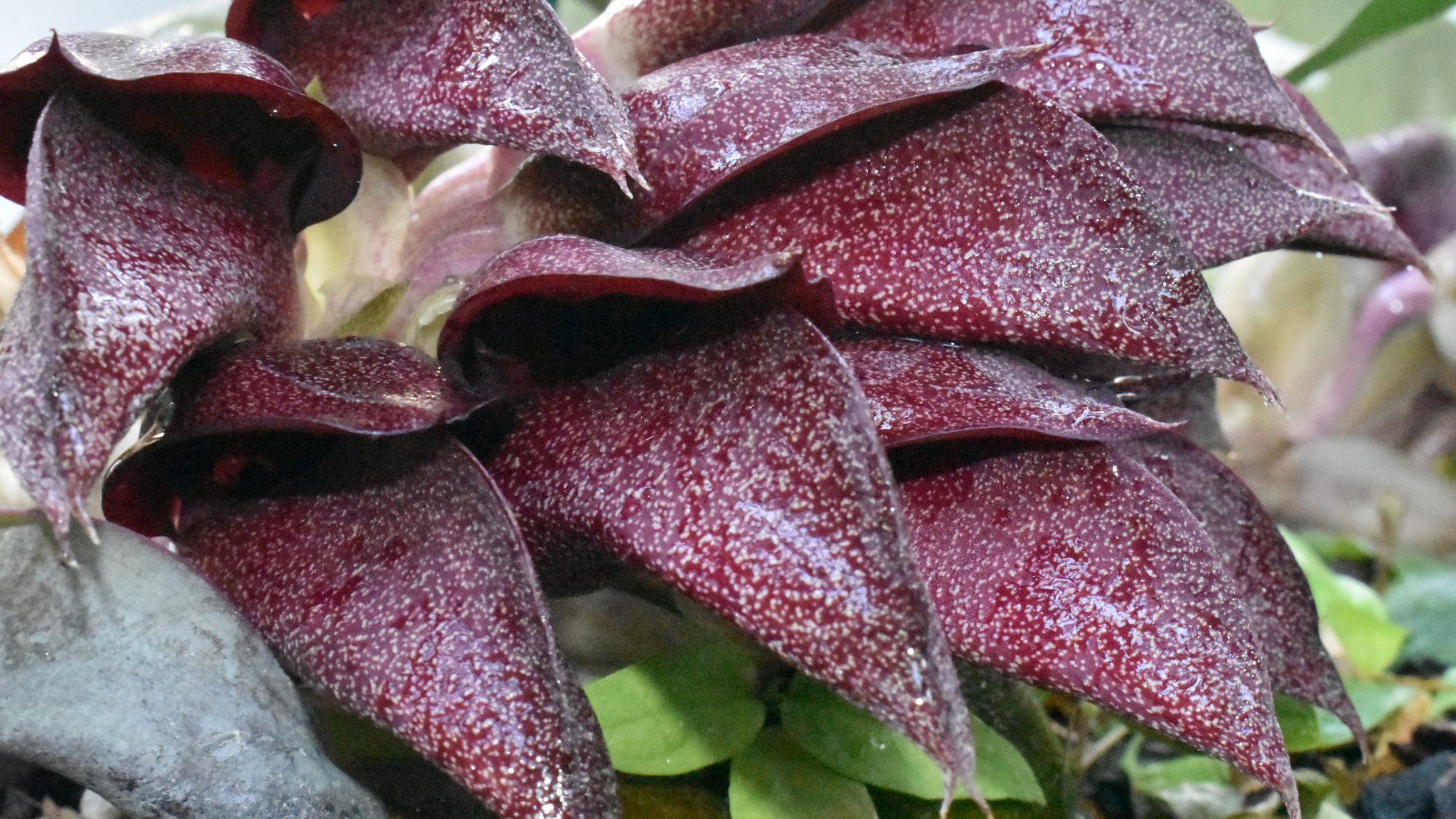
This unusual orchid is displaying dark, malodorous flowers in the Palm House.
Containing approximately 600 genera and an estimated 25,000 – 30,000 species the orchid family (Orchidaceae) is the largest plant family in the world. Members of the family occur in all continents except Antarctica, and are found in mountainous areas, semi-arid deserts, coastal plains, meadows, woodland, and tropical rainforests. Species are perennial, saprophytic, epiphytic, aquatic, subterrannean or scrambling in their habit. The genus Bulbophyllum comprises some 2100 species from tropical zones of South America, Africa, Asia and Australasia. It is the largest orchid family, and members occur in high and low altitude rain and tropical forests. Species are highly diverse in their flower form and shape. B. fletcherianum is endemic to New Guinea where it grows in humid areas on rocky outcrops and mossy branches. Each inflorescence bears up to 30 individual, hooded, deep red flowers whose unpleasant fragrance has been compared to ‘a whole herd of dead elephants’. This species was described and named by J G Fowler in 1914 to commemorate the renowned orchid grower Rev. J C B Fletcher of Chichester, England. Several common names are applied to this species, including Fletcher’s orchid and the tongue orchid, in reference to the leaves, which can grow to 1.8m in length.