
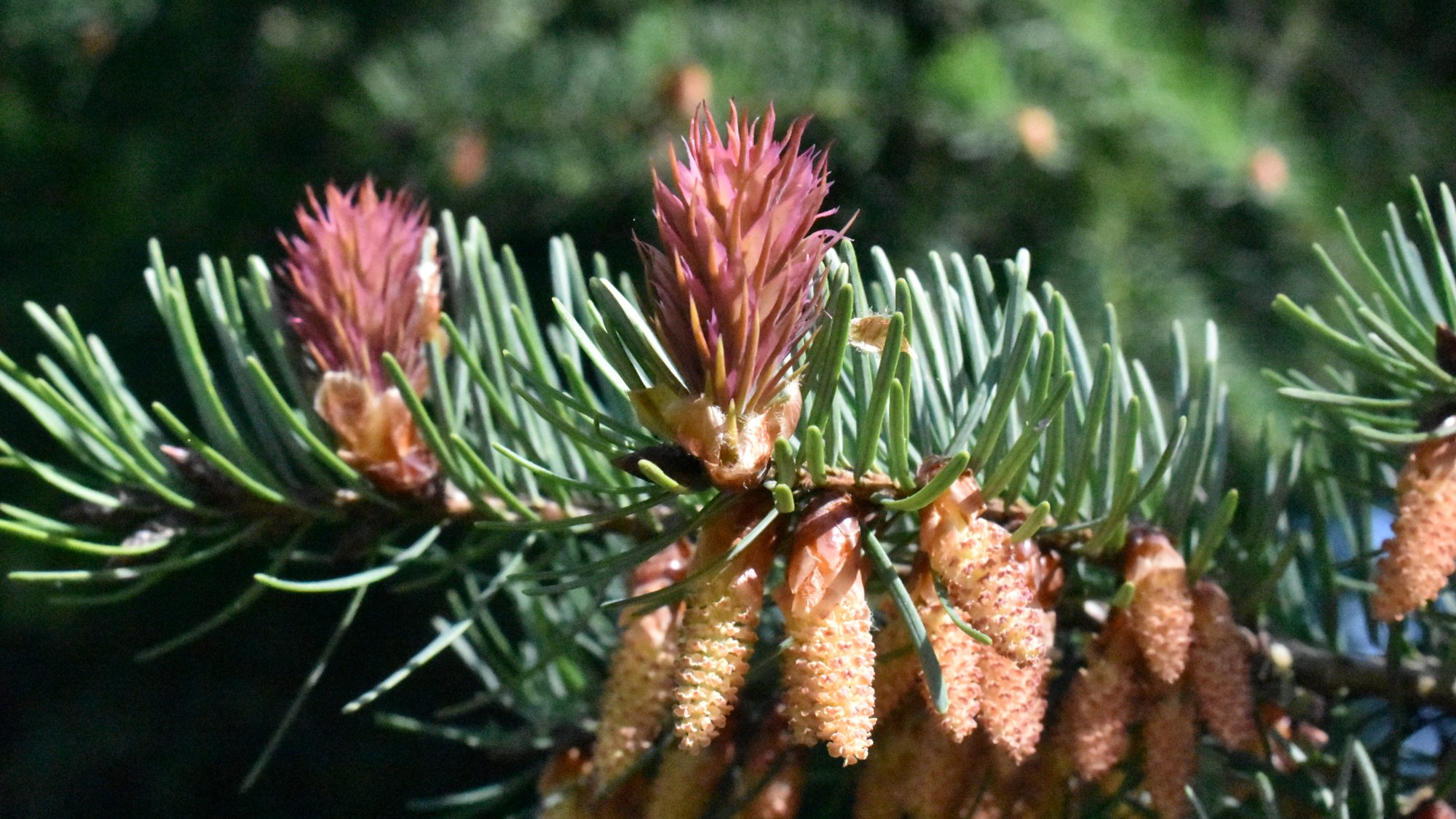
The Douglas fir is displaying male and female cones in the New Pinetum.
The genus Pseudotsuga contains four coniferous species from China, Japan and western North America. All species have distinctive bark, which is scaly when young and matures to take on a cork-like appearance. They bear spirally arranged needle-like leaves, and clusters of short, male pollen cones, and single female cones which are erect at pollination, but which develop to form pendulous cones. P. menziesii is a North American native, introduced to our gardens in 1827 by the Scottish plant collector David Douglas, having been discovered in 1793 by the Scotsman Archibald Menzies. The Latin and common names commemorate both of these Scotsmen. It is a single-stemmed species which can reach 100m, making it one of the tallest tree species, and it is estimated to live for up to 1000 years. In its native North America it occurs in a band from British Columbia to Mexico, flourishing in areas of high rainfall. The leaves, or needles, occur in two ranks, and are paler, or more glaucous, on the underside. The pendulous cones can be up to 10cm, and have bracts emerging from beneath the scales. Pseudotsuga menziesii is a highly valued timber tree, and is widely used in the construction industry, and it has also been used medicinally for the treatment of coughs and bronchitis.