January can often feel like one of the gloomiest and longest of months, with the Christmas hubbub over and a diminished sense of optimism.
Even for the hardiest, most enthusiastic gardener, the idea of spending time in the garden can wane, but winter flowering plants such as mahonias and viburnums can brighten the darkest winter days. For me though it is hard to beat the sense of cheer provided by delicate snowdrops, or Galanthus to give them their botanical name. From the moment their slender leaves pierce the soil in the depths of winter, there’s a sense that things are on the up, and the emergence of their first flowers instantly lifts the spirits.


Understanding snowdrops
When talking about snowdrops, gardeners often come across three ways they are described – species, cultivars and hybrids. A species snowdrop is a naturally found type of snowdrop, such as Galanthus nivalis or Galanthus elwesii. A cultivar (short for cultivated variety) is a plant selected by gardeners or growers for a particular trait – maybe unusual markings, double flowers or an early bloom. Hybrids happen when two species are crossed either by nature or by humans, producing plants that blend features of both parents.
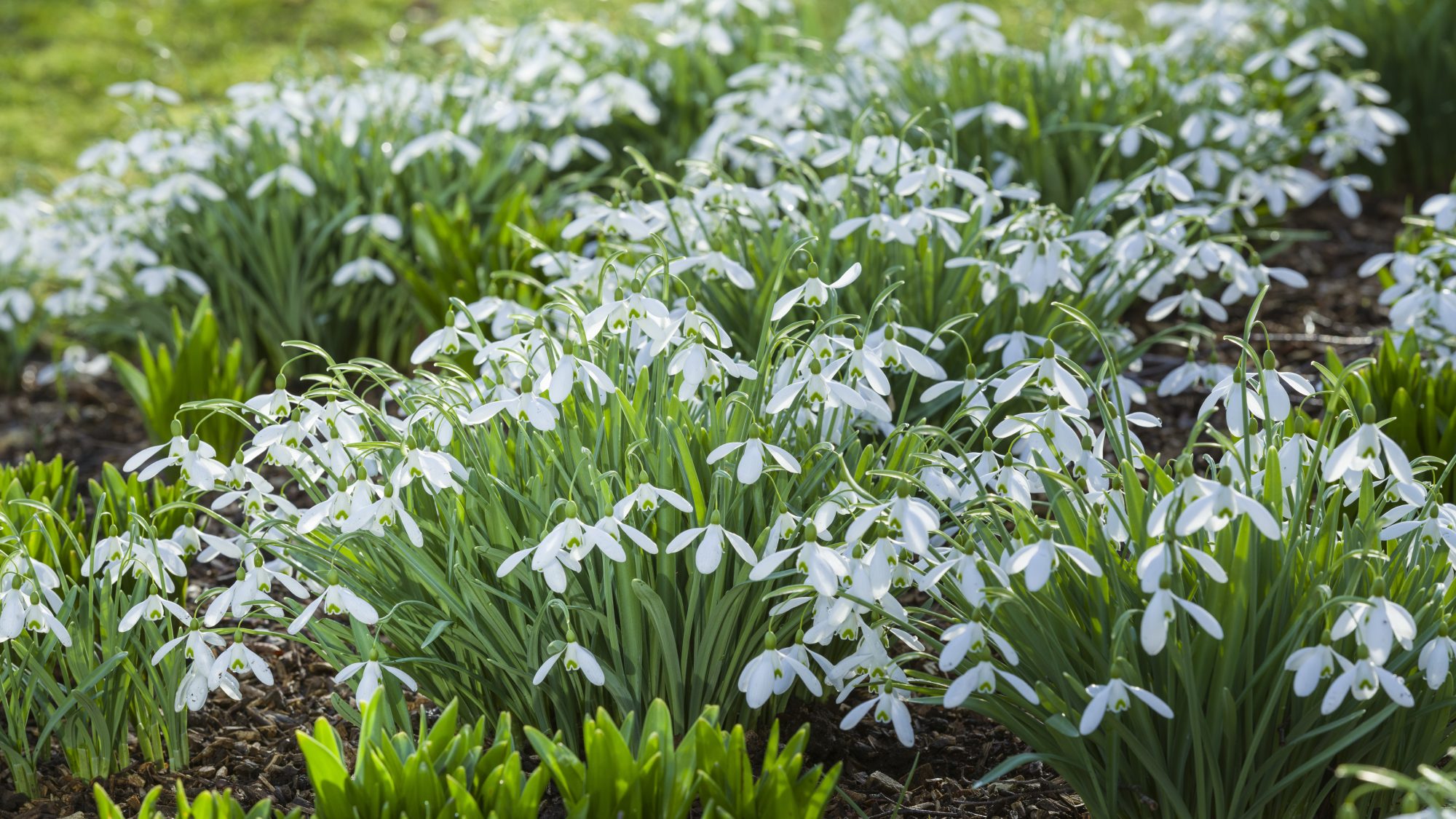
Here at the Botanic Garden, we have a diverse collection of approximately 40 snowdrop species, hybrids and cultivars, which visitors can enjoy throughout winter. Some are grown in only small numbers, such as cultivars ‘Kite’ and ‘Anglesey Abbey’, but others such as Galanthus ‘Magnet’ thrive and produce carpets of nodding white blooms which flutter in a breeze. And the humble common species (G. nivalis) is naturalised in wilder areas of the Garden, but is frequently found in woodlands throughout the United Kingdom. With a native range from the Pyrenees to Ukraine, G. nivalis is known to have been grown here since the sixteenth century, though some accounts suggest that it may have been introduced by the Romans. Other species are less widely grown in our gardens, but such is the appeal of this diminutive winter-flowering species that there are estimated to be up to 2,500 different hybrids and cultivars, satisfying the appetite for snowdrops of the most dedicated ‘Galanthophile’.


Spotting the differences
Snowdrop species, hybrids and cultivars are common in having solitary white flowers, and in usually displaying three inner tepals with green or yellow markings, and three larger, unmarked outer tepals. Tepals are the petal-like segments of the flower – botanists used this word because in snowdrops the petals and sepals (the outer protective leaf-like parts which protect flowers when in bud) look alike, so botanists call them tepals. What makes each variety distinct is the size and shape of the green marking, the shape of the flower, the size and position of the tepals, leaf shape and texture, height and even vigour in the garden. Among the range of forms available there are a number of widely grown, reliable forms. Galanthus elwesii, a Balkan species has broad, glaucous leaves to 30cm in height, and broad outer tepals and a green arc on the inner tepals. In contrast, the cultivar ‘S. Arnott’ has shorter, narrower leaves, delicate outer tepals and a thin v-shaped mark at the tip of the inner tepals. If you fancy something a little rarer, ‘Trym’ is a charming choice, with tubular-looking flowers, with the inner and outer tepals having a green apical mark and notch. And while the range of forms is almost endless, the sky’s the limit with regard value, with an individual bulb of the rare ‘Golden Tears’ reaching £1,850 in 2022.


Growing snowdrops at home
Whether it’s the rare and expensive, or the more widely grown forms that you prefer, all enjoy dappled shade in well-drained, humus-rich soils. Bulbs can be purchased in autumn, but the best way to plant snowdrops is ‘in the green’ (planting them when they are still in leaf). As such, they are easy to place in the garden beneath trees and shrubs, but also amongst herbaceous plantings – there really isn’t an easier way to add winter interest to your garden! If you are buying snowdrops, make sure to purchase them from a reputable source. Many snowdrops are protected in the wild as their habitats are under threat from destruction for housing or agriculture, and wild populations have also been diminished due to intense collecting for the horticultural trade.


Where to see snowdrops in the area
Of course, you may prefer to simply enjoy admiring snowdrops in somebody else’s garden or woodland, and there are several East Anglian gardens with stunning snowdrop displays, including Anglesey Abbey, Chippenham Park, Benington Lordship, Walsingham Abbey and Easton Walled Gardens. Here at the Botanic Garden we have a lovely snowdrop trail which is a wonderful way of discovering the subtle differences between these joyful flowers and more about them. A word of warning though: once you’ve dipped your toes into the world of snowdrops you may be in danger of developing ‘Galanthophilia’!


Gardening jobs for January
- Look through seed catalogues and plan what you’re going to grow from seed this year.
- Finish clearing debris and leaves from the garden.
- Cut back hellebore leaves to reduce the risk of black spot, and to expose the flowers.
- Continue covering tender plants if frosts and snow occur.
- Clean pots and tools, and tidy tools sheds.
Sally’s ‘top of the drops’ from Cambridge University Botanic Garden’s snowdrop trail:
- Galanthus nivalis ‘Flore Pleno’ – loved for its double flower
- Galanthus elwesii named after Henby J Elwes, a British botanist who identified the original plants in Turkey. The flowers have two green spots on the inner tepals.
- Galanthus ‘S. Arnott’ – a great one for bulking up with a light honey scent. Named after the keen gardener and snowdrop fanatic Samuel Arnott
- Galanthus ‘Magnet’ – its flowers nod gracefully in the wind and have a V-shaped green mark on their inner segments
- Galanthus nivalis ‘Scharlockii’ – often called the ‘donkey’s ears snowdrop’ with its long green petal-like collar (spathe) split into two ‘ears’