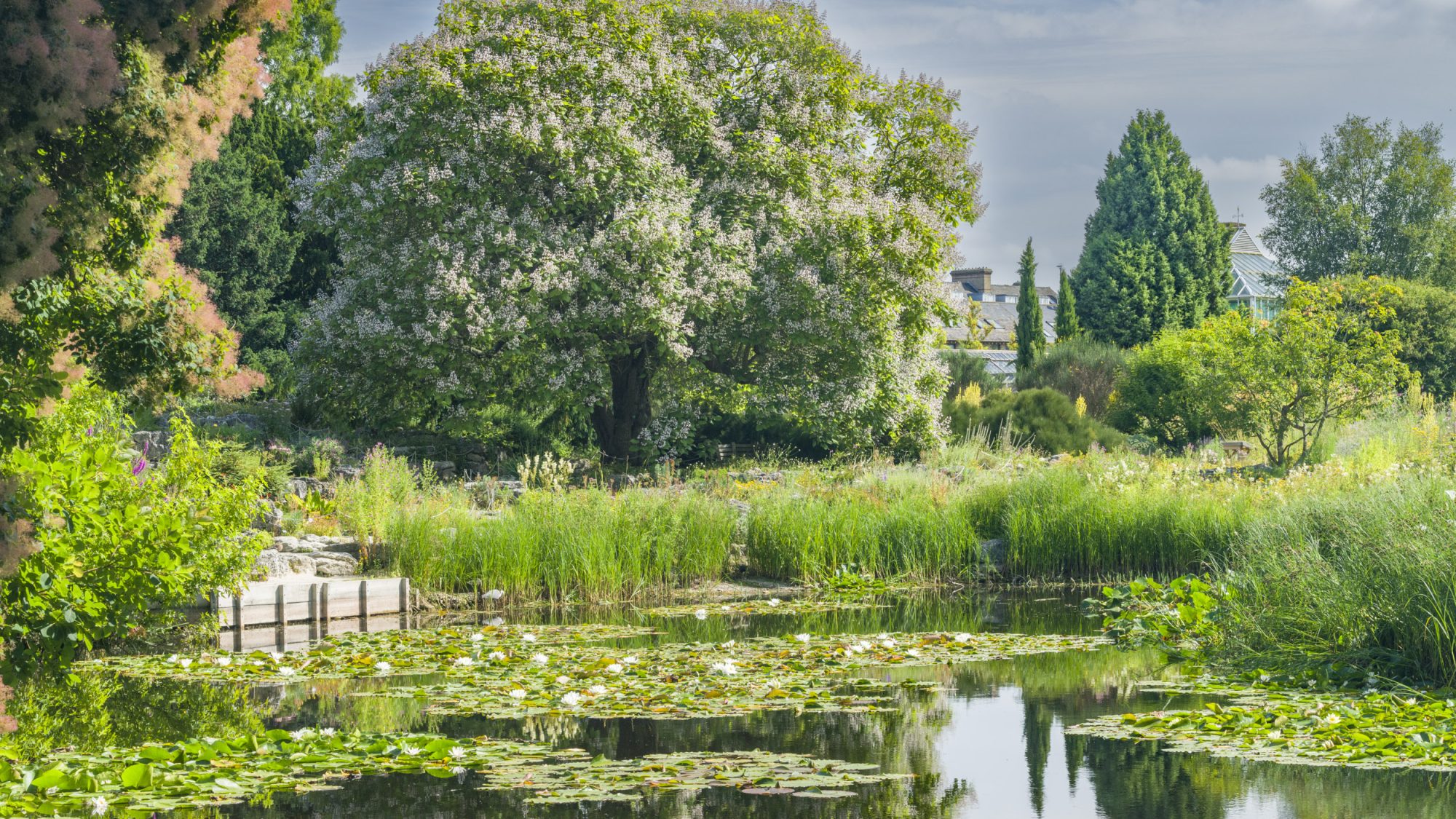
Over the next couple of months, the skyline here at Cambridge University Botanic Garden will quietly transform. High above our heads, our diverse tree collection – comprising of approximately 2,000 individual specimen – awakens with a remarkable display of flowers. From landscapes around the world, the collection ranges from the low, spreading Betula medewediewii (Caucasian birch) from the Caucasus, to the towering coniferous Sequoiadendron giganteum (giant redwood) from California and the eye-catching Chinese pocket handkerchief tree (Davidia involucrata).
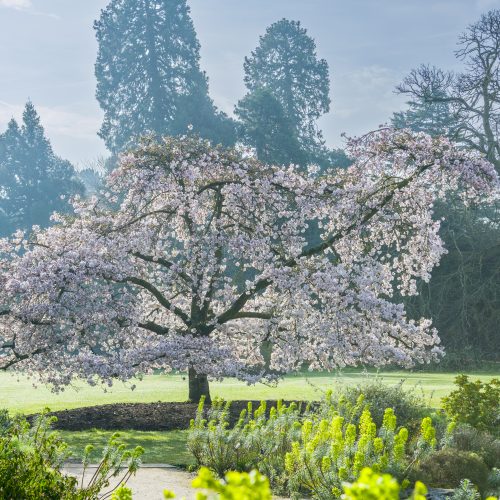
Many of these produce vibrant, colourful flowers in the spring and summer months, including the flowering cherries (Prunus species and cultivars) with their clouds of delicate blossom, and the horse chestnuts (Aesculus hippocastanum and A. Indica) whose flower spikes or candles fill the canopy in May. Others, however, produce tiny, discreet winter and spring flowers borne on catkins. Many familiar trees are catkin-bearing, including the native silver birch (Betula pendula) and English oak (Quercus robur). While they may not compete with the vibrant blooms of many spring and summer-flowering species, they hold infinite variety and interest during the colder, darker months.
Flowers, catkins and clever pollination


Have you ever wondered why there is such as distinction between the attractive petalled flowers of trees such as the cherries and horse chestnuts and the less striking catkins of birches and oaks? The answer comes down to pollinators.
In areas where pollinators are plentiful – whether it be insects, birds, bats or even rodents – plants produce flowers in which the reproductive organs (anthers and stigma) are surrounded by petals. The flowers are often large, colourful, or scented, or a combination of all three, and these are highly attractive to specific pollinators.
In these flowers large, sticky pollen grains are attached to the male anthers inside the flower, and attach to the body of the visiting pollinator while it forages for nectar. When the pollinator visits another flower searching for more nectar, the pollen it collected from the first flower will be deposited on the sticky female stigma of the second flower. In essence, while searching for food, the foraging animal inadvertently pollinates the flower – a mutually beneficial relationship in which the plant and the animal gain.
Whatever the season, a closer look at the flowers or catkins of the myriad of trees around us reveals intricate details and will leaves us in awe of the intricate and remarkable mechanisms plants have evolved to maximise the chances of pollination and regeneration.
This isn’t the end of the story however. Some plants encourage pollination with nectar guides – markings that help direct pollinators to the nectar source. In the case of the horse chestnut, the flowers display yellow blotches, that act as nectar guides, which attract bees to the flower in their search for pollen. Once pollination has occurred, this yellow blotch turns red, a colour which bees can’t see, signalling that the flower no longer needs visitors. If the flower remains unpollinated, this yellow mark will age to red after about two days, as the nectar production decreases. Clever stuff.
In areas where there are few pollinators though, plants rely on a different mechanism for pollination and seed fertilisation. Trees such as the birches and hazels, flower from January to March, before the leaves emerge. At this time of year they have little chance of attracting pollinators, so instead have evolved to develop wind pollinated structures in the form of catkins. These are slender structures formed of many small, dull, petal-less flowers which have no scent or nectar, but which have male pollen-producing anthers held on fine filaments, and feathery female stigmas.


Male catkins are longer than the females, and tend to flower earlier, while the female flowers are shorter. In birches, the short female catkins are erect before pollination and hang down after pollination. The oak, (Quercus robur) has long, thin, string-like, yellow-green male catkins, and small red female flowers, while the aspen (Populus tremula) has distinctly downy, pendulous catkins.
In all wind pollinated trees, each individual catkin carries either male or female flowers, but a tree may have both male and female catkins (monoecious), or may have male and female catkins on separate plants (dioecious). The pollen grain of these catkin-bearing plants is tiny and produced in large amounts on the anthers so that it can be carried in the wind and ultimately deposited on the female stigmas of another flower.
While less conspicuous than petalled flowers, these plants add welcome interest during the winter months – though be warned as they can also act as an allergen, causing hayfever during late winter and spring. Whether animal pollinated (zoophilous) or wind pollinated (entomiphilous), the process results in seed fertilisation and the continuation of future generations of a species.


A stroll through any garden, park or neighbourhood will reveal a host of trees. Those with petalled flowers, such as the cherries, horse chestnuts are eye-catching and attractive in their appearance to both insects and humans alike. Wind pollinated trees may not have the kerb appeal of their vibrantly coloured counterparts, but close inspection of these reveals variety in colour and size.
Whatever the season, a closer look at the flowers or catkins of the myriad of trees around us reveals intricate details and will leaves us in awe of the intricate and remarkable mechanisms plants have evolved to maximise the chances of pollination and regeneration.
Gardening jobs for May
- Harden off tender plants such as tomatoes and bedding plants, but bring indoors or cover them with fleece if there’s a risk of frost.
- Plant tender perennials at the end of the month after the last frost.
- Pinch out the tips of bedding plants to encourage strong, bushy growth.
- Sow dwarf, French and runner beans directly in the garden once soil has warmed.
- Put plant supports in borders to support herbaceous perennials and climbers such as sweet peas and Spanish flag.