
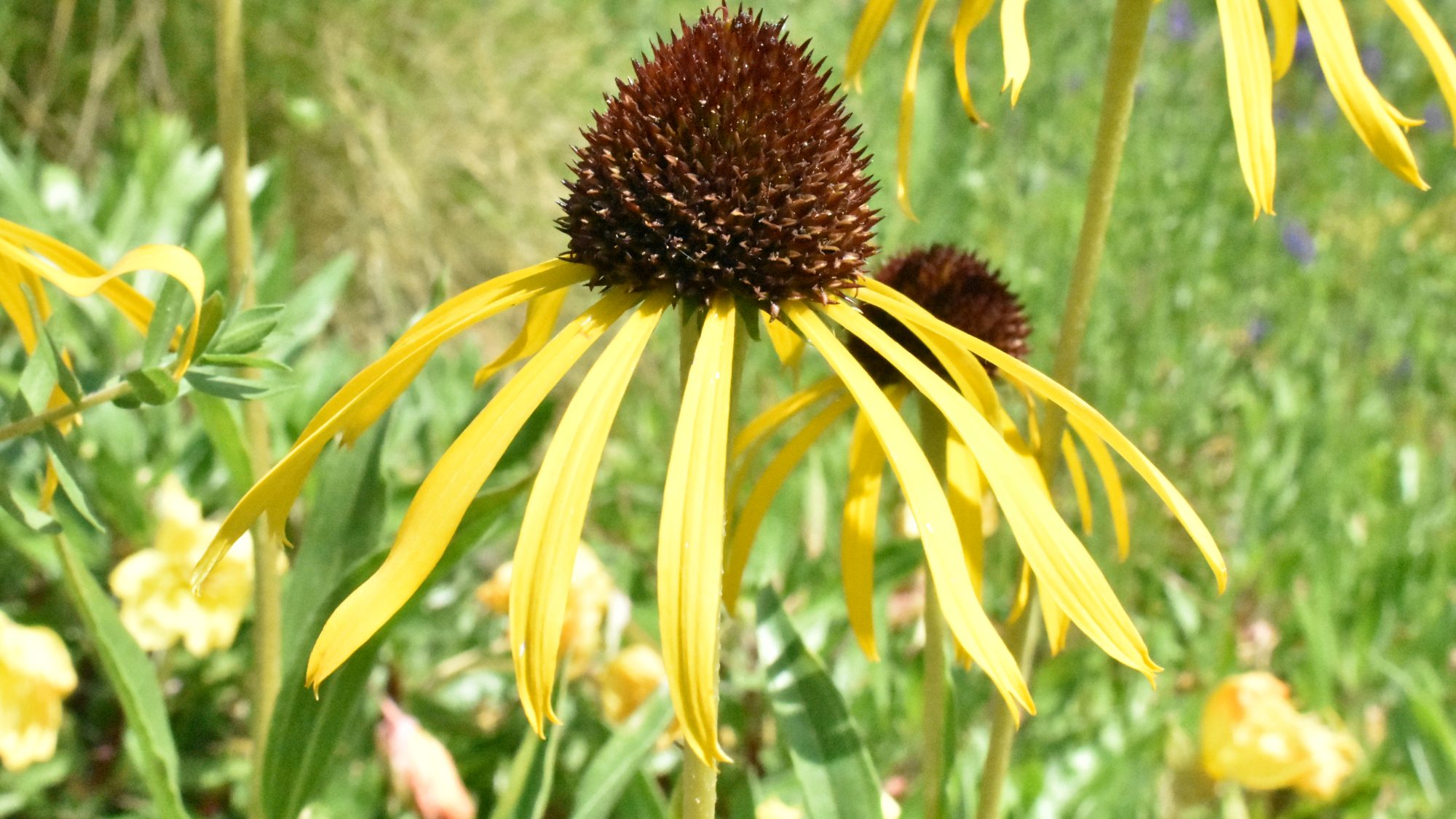
The yellow cone flower is making a statement in the Dry Meadow.
The genus Echinacea contains nine perennial species from Canada and the United States. They have a conical central boss surmounted by radial petals and occur in prairies, rocky and gravelly hillsides, and open woodland. E. paradoxa occurs in prairies of Arkansas and Missouri. It is a clump-forming species with lance-shaped, narrow leaves. The erect flower stems reach up to 1m in height, and bear solitary terminal blooms which have a distinct cone-shaped central disc and golden-yellow, drooping ray florets. This is the only yellow species of Echinacea, the others all having pink or purple flowers, hence the species name paradoxa. The generic name Echinacea comes from the Greek for hedgehog, echinos, and refers to the prickly texture of the central disc floret.