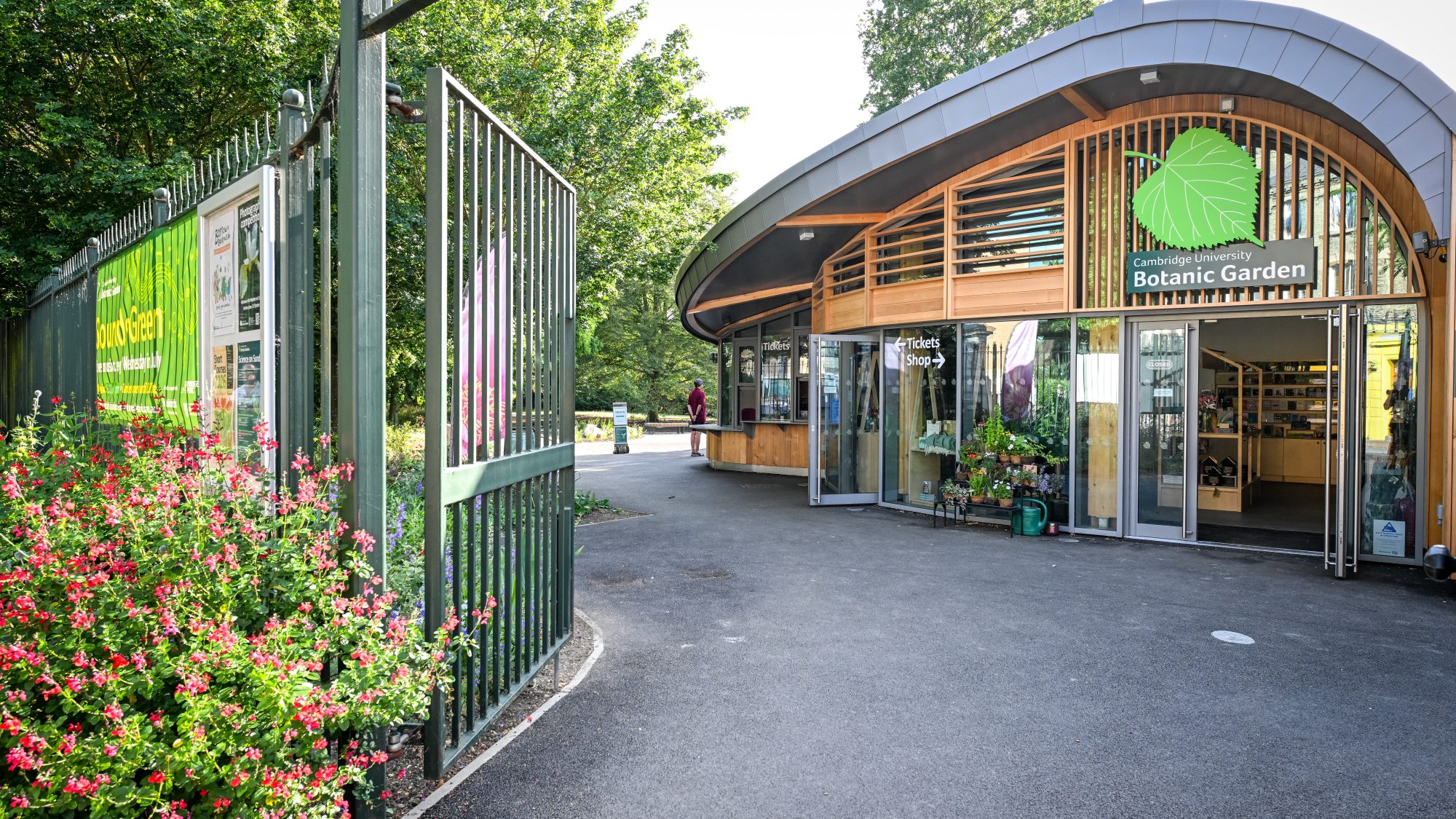
Cambridge University Botanic Garden marked a significant milestone at its recent Director’s Drinks Midsummer Party, celebrating the opening of the new Station Road Visitor entrance which opened to the public earlier this year and marks an important enhancement to the Garden’s accessibility and visitor experience.
The evening event followed an opening ceremony beside the new building and landscaping before guests gathered in the Garden’s shady Autumn Colour area. The celebration brought together key stakeholders, including the project’s funders Thalia WB Community Fund, members of the University’s Estates Division and colleagues from across the Garden and wider University and Cambridge community, to recognise the collaborative effort behind the delivery of the new entrance and ticket office.


Cambridge University Botanic Garden’s Director, Professor Beverley Glover, spoke about the significance of the project:
“It is wonderful to see how this part of the Garden has evolved. What was once a secondary entrance here at Station Road has become the main gateway to more than half of our visitors, and it is only right that their first experience reflects the quality and ambition of the Garden as a whole. This fantastic new building allows us to offer a far warmer welcome, with improved ticketing, retail and visitor facilities including toilets, that make a real difference to every visit.
I am particularly pleased that we now have a space here where people can pause and browse, whether they are regular visitors or simply passing by from the surrounding area.
This project has been a truly collaborative effort, and I would like to thank everyone involved – from our partners in the University Estates division to the architects, builders and, of course, our generous supporters including Thalia Community Foundation and Cambridge Community Foundation.
It has also given our horticulture teams a rare chance to shape an entirely new landscape, drawing together expertise from across the Garden to create something that is both beautiful and botanically rich, and which will continue to evolve and inspire for years to come.”
This project has been a truly collaborative effort, and I would like to thank everyone involved – from our partners in the University Estates division to the architects, builders and, of course, our generous supporters including Thalia Community Foundation and Cambridge Community Foundation.


David Hills, Director of Programme Delivery for the University’s Estates Division, said:
“This project has been a real success for the Estates Division and the Cambridge University Botanic Garden. The new ticket office looks fantastic and provides a suitable and practical space to welcome the more than 150,000 visitors who will pass through each year. The new building connects with and draws people in from the busy Station Road area, creating an attractive and welcoming gateway into the Cambridge University Botanic Garden.”
Kevin Benstead, Account Director, at Thalia Waterbeach, added: “We’re immensely proud of the links we have built, and continue to build, with the communities and organisations we serve in Cambridgeshire. It’s a privilege for us to have been able to support the Cambridge University Botanic Garden project, and our hope is that the garden will serve as a space for individual reflection and inspiration, but also an area that brings people together through the mutual enjoyment and appreciation of the care, collaboration, and dedication it represents.
Collaboration is one of Thalia’s core People Values, and being able to play even a small part in bringing this project to fruition reinforces the responsibility we feel as a business to support the local communities and organisations who continue to build a legacy of learning, inclusion, and excellence across Cambridgeshire and beyond ”
Ceremonial tree planting
A highlight of the evening was the ceremonial planting of a commemorative tree by the University’s Pro-Vice-Chancellor for University Community and Engagement, Professor Kamal Munir. The tree, Pyrus regelii, planted in the new landscape behind the new Visitor Welcome Building holds particular significance, having been collected during a 2023 Cambridge University Botanic Garden expedition to Kyrgyzstan and later propagated from seed by the Garden’s Glasshouse Team. Its planting reflects CUBG’s ongoing commitment to plant exploration, conservation and scientific research.
Professor Munir said: “This new welcome building marks a significant moment in the life of the Garden, providing an arrival experience that reflects its standing as a place worthy of the excellence it represents while also serving the city and its communities. With more than 360,000 visits each year, the Garden plays a vital role in connecting the University with Cambridge and its visitors.
CUBG is a place where world-leading plant science becomes visible and accessible, enabling people to engage directly by seeing, touching and understanding the vital work on biodiversity, food security and climate resilience. Through its learning programmes and partnerships with schools, community groups and charities, it also demonstrates the University’s commitment to ensuring that this knowledge is shared as widely as possible.
The tree I have the honour of planting captures that spirit perfectly. Grown from seed collected by the Garden’s team on expedition, it represents the journey from exploration and discovery to conservation and public engagement, and its place here in the Garden for generations to come.”


CUBG is a place where world-leading plant science becomes visible and accessible, enabling people to engage directly by seeing, touching and understanding the vital work on biodiversity, food security and climate resilience.
New landscape rooted in resilience and exploration
The landscaping surrounding the Station Road entrance has been designed in line with the Garden’s horticultural priorities – emphasising climate resilience, low water requirements once established and the showcasing of wild-collected and expedition-derived plant material.
CUBG’s Head of Horticulture, Sally Petitt, who devised the layout explains:
“Many of the species in the new planting have been propagated in-house from existing accessions, alongside new material introduced through recent expeditions. The planting also features wild tulips that reflect our National Collections and several taxa not previously cultivated at the Garden, giving us valuable opportunities to assess their performance under local conditions. With many species selected for their ability to thrive in a hotter, drier climate, the scheme also celebrates plants with local significance, including Bergenia ‘Bressingham Ruby’ and Iris ‘Bressingham Ruby’ both of which have strong connections with East Anglian gardens.”


A collective effort
From a horticultural perspective, the project has been a significant undertaking and a true team effort. The landscape design was developed at the building planning process, but physical work began in January 2026, in a very wet winter. Hard landscaping was completed in June 2026, when much of the planting was also carried out, though further planting in the wider landscape will be carried out in autumn. Colleagues from the Landscape and Display Teams played leading roles, supported by staff involved in plant collection, propagation and planting. The Glasshouse Team, in particular, has cultivated a large proportion of the plants used in the scheme.
Despite various weather-related and logistical challenges encountered during delivery, the completed landscape provides a welcoming expression to CUBG’s visitors of its mission to be an inspirational, world-leading botanic garden, recognised for excellence in learning, research and horticulture. As a welcoming new gateway to the Garden, it also offers visitors a beautiful place to relax, explore and connect with nature, while showcasing the Garden’s world-class living collections and its work in plant conservation, research and sustainable horticulture.
As Beverley concludes: “The new visitor entrance embodies CUBG’s commitment to sharing the wonder of plants and fostering a deeper appreciation of the natural world among local communities, visitors and plant lovers from across the UK and beyond. We look forward to welcoming both long‑standing visitors of the Garden and those discovering it for the very first time – inviting everyone to explore, enjoy and feel inspired by this beautiful place.”