
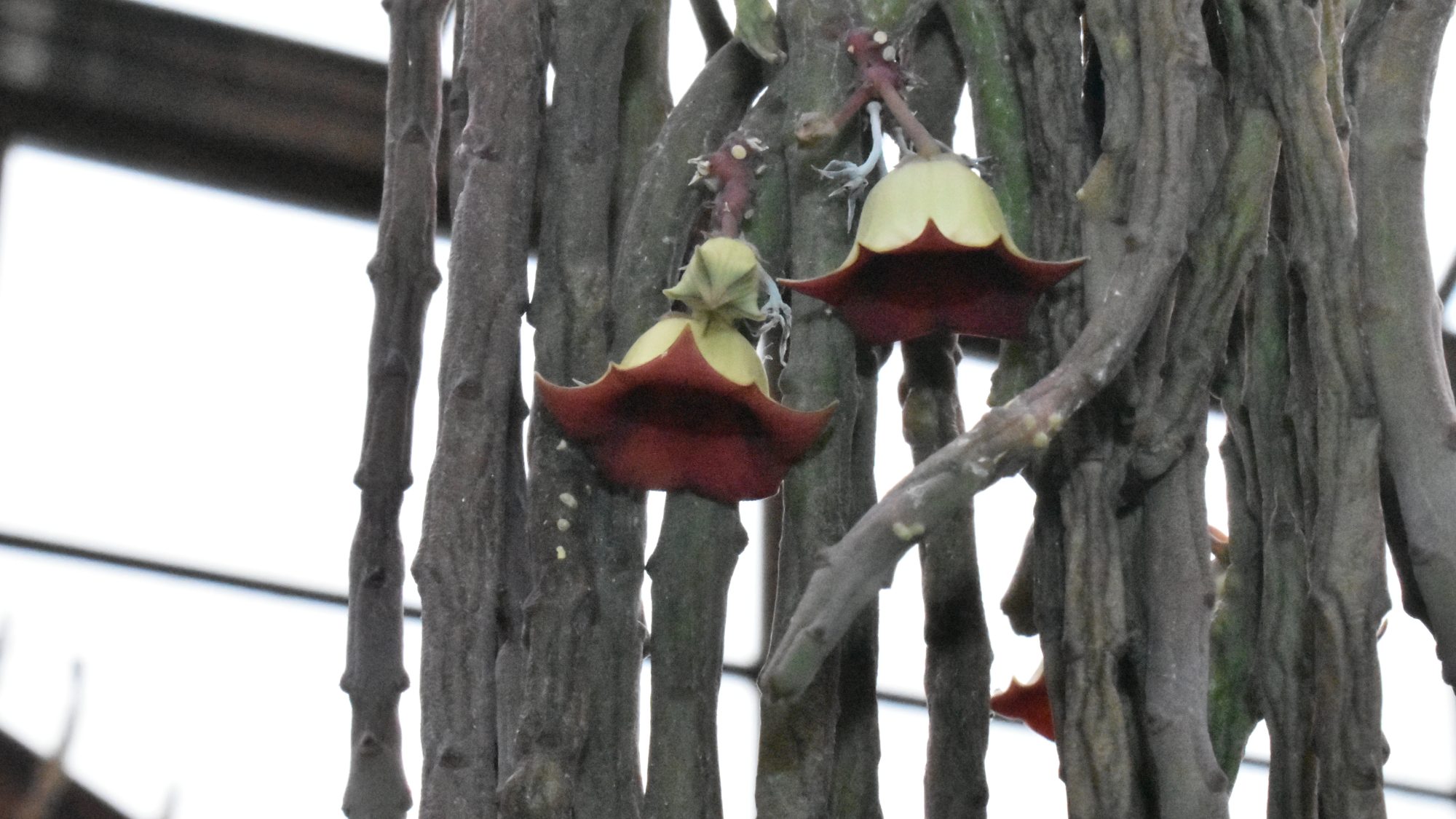
This succulent plant is bearing attractive flowers overhead in the Arid House.
The genus Huernia contains over 70 succulent species from the African continent, with the majority occurring in east Africa from the Cape to the Arabian Peninsula. The genus belongs to the Apocynaceae (milkweed family) which also contains the familiar houseplant Hoya and the hardy perennial Vinca. Many members of the family are toxic, and some species have been used as poisons in the past. The genus takes its name from a seventeenth century Dutch missionary Justus Heurnius who recorded the first two succulents (Cotyledon orbiculata and Orbea variegata) on South African soil when he travelled on the ship Gouda to the Cape of Good Hope in 1624. H. pendula comes from the eastern Cape of South Africa, where it grows on cliffs in dry river valleys. The succulent, grey-green stems are angled and reach almost 1m in length, and these change in colour to light brown or purple during the dry season. Three to four flowers are held in cymes near the base of the stem and lateral branches. These have short pedicels, or stems, and an open, bowl-shape, with a deep maroon inner, and produce a scent of rotting meat to attracts pollinating flies.