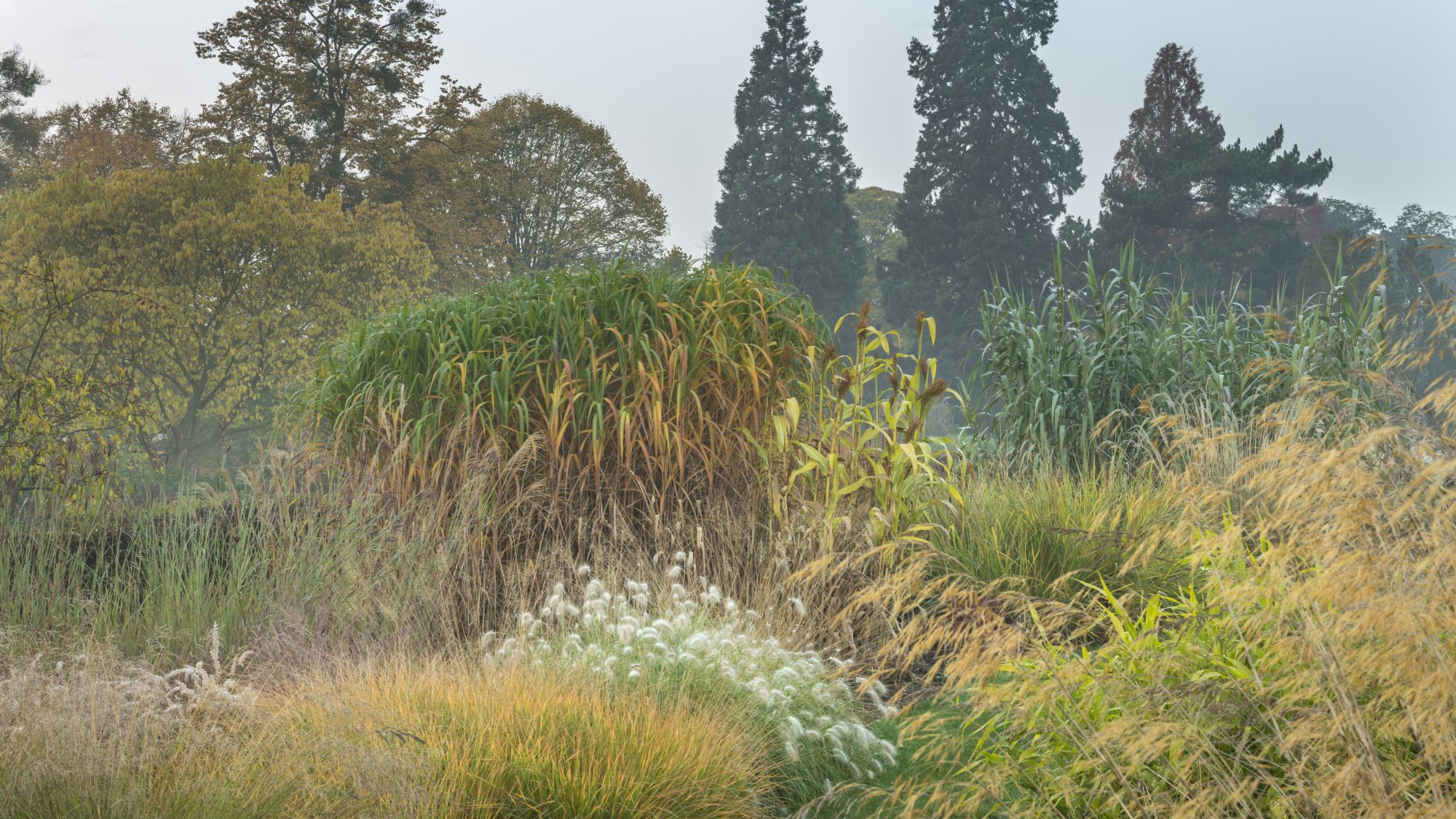
Grasses can be invaluable in adding movement, texture and sound to a garden or wider landscape. The swaying stems of a field of barley (Hordeum vulgare) can be mesmerising when moving rhythmically en-masse, and the rustling leaves of great reedmace (Typha latifolia) bring a distinct sound to a fen landscape.
While most of us will not be able to consider including them on such a large scale in our own plots, ornamental grasses are invaluable in adding not only movement and sound, but also texture. Even in the smallest space the addition of grasses can transform a planting scheme.
Not only though do they bring elemental interest to a space, they are also proven to be beneficial to our health and wellbeing. Their subtle colouring in the growing season, and their neutral tones through autumn and winter are calming; their graceful movement as they rhythmically sway is enchanting; and their sound in a breeze is soothing. Who can resist walking beside a swathe of the North African feather top grass (Cenchrus villosum) and brushing your hands through their soft foliage and flower spikes – I know I can’t.
The grass family


There is a wealth of grasses favoured by gardeners, but did you know that the grass family (Poaceae) is one of the largest plant families containing approximately 800 genera and 12,000 species. It is a truly cosmopolitan family, occurring from sea level to high altitudes, in temperate, tropical, arid, wetland and mountainous habitats, and plants can be terrestrial or aquatic.
Records indicate that grasses are the main component in 25% of the earth’s vegetation cover and form the basis for essential ecosystems such as savannahs and prairies. Poaceae is also the most economically important plant family containing crop plants such as wheat, barley, oats, maize, rice, rye, sorghum, and millets, and also bamboo which is used in construction. Members of the family have been widely used in traditional medicines for the treatment of ailments such as indigestion, colds and bruises.
Today grasses are used in the production of many items, including fibres, starch, aromatic oils, alcohol, sugar, baskets and buildings. Some members of the family are invaluable in stabilising soils such as the native marram grass (Ammophilia arenaria) which grows on coastal sand dunes. Many members of the genus provide food and habitat for a range of birds, mammals and insects.
Members of the grass family are distinguished by their slender leaves bearing longitudinal parallel veins, and their panicles of spikelets, or grass flowers. Species are evergreen or deciduous, and are annual, biennial or perennial in their habit, with the bamboos being woody. Their stems, or culms, are hollow, and the sheathed leaves have a broad base with which they appear to clasp the stems.
Grasses in the garden


Given the size of the family, and their wide ornamental appeal, there is pretty much a grass for all garden styles and conditions. A grass garden can be impressive, and here at the Botanic Garden our Systematic Beds contain a display of members of the Poaceae, which highlights the diversity within the family.
For many of us though our horticultural tastes are rather too broad to limit ourselves just to grasses. For those encouraged to dive into the world of grasses for the first time be sure to pick the right plant for the right place. If you have light shade and moisture Japanese forest grass (Hakeonochloa macra ‘Aureola’) is a great choice. Anemanthele lessoniana (pheasant’s tail grass) is the only component in our grass maze, and this enjoys dry conditions in sun or shade, and its billowing mounds are attractive, tactile and full of movement throughout the year.
Grasses can add form and texture to herbaceous beds, breaking up the cacophony of colour and the rigid forms of many perennials with their graceful form and motion. Nasella tenuissima, or Mexican feather grass, grows to approximately 60cm tall, and along with greater quaking grass (Briza maxima), is a perfect for inclusion in a sun-baked gravel garden. Taller species such as the giant oat grass (Celtica gigantea) has flower stems to 2.5m, and these take on a golden glow in sunlight and it makes a wonderful specimen, while Calamagrostis x acutiflora ‘Karl Foerster’ is an erect perennial favourite, valued for adding punctuation to a border.
Poaceae is not only the most important family of economic value, but its immense diversity also offers a great selection for use in our gardens. Whatever your situation there will be a grass for you, but when selecting consider your soil type and light levels to ensure you make the right choice. You may choose to grow edible maize, but there are also plenty of options providing ornamental value. They bring valuable movement, texture and sound to the garden, and have the added bonus of being calming and soothing. I for one can’t imagine a garden without them.


Gardening jobs for September
- Continue harvesting fruit and vegetables such as potatoes, beetroot and tomatoes.
- Divide and plant congested clumps of herbaceous perennials such as Geranium and Epimedium.
- Plant spring flowering bulbs like Crocus, Narcissus and Fritillaria.
- Collect and sow seed from perennials and annuals.
- Install water butts beneath down pipes to store water for use later in the garden.