Back to the page
  • Welcome
  • Visit us
    • Visit us
    • Opening times & information
    • Book Tickets
    • Visiting – travel, dogs, toilets, etc.
    • Garden map
    • Group Visits
    • Tours
    • Press and photography
    • The Garden Café
    • Garden Shops
  • Accessibility
  • What’s on
  • The Garden
    • The Garden
    • About the Garden
    • Horticultural Collections
    • Understanding Plant Labels
    • History of the Garden
    • Wildlife
    • Plant picks of the week
  • Learning
    • Learning
    • Short Courses
    • Certificate in Horticulture
    • Certificate in Botany
    • Schools
    • Colleges and Universities
    • Family Activities
    • Communities
    • Science on Sundays
    • Trails for Adults
  • Science
    • Science
    • Our Science Staff
    • Our Staff Publications
    • Your Science
    • Supporting Your Research
    • Phenology Project
  • Collections
    • Collections
    • Living Collections
    • Seed Bank
    • Herbarium
    • Cory Library
    • Archives
    • Living Collections Portal
    • Botanic Dyes
  • News
  • Support Us
  • Friends
    • Friends
    • Join the Friends – signing up is easy!
    • Friends’ Events
    • Corporate Support and Corporate Friends
    • Gift Membership Vouchers
  • Cambridge Botanic Lights 2026
    • Cambridge Botanic Lights 2026
    • Cambridge Botanic Lights – Frequently Asked Questions (FAQs)
    • Cambridge Botanic Lights – Accessibility
    • No gnome left behind: Donate your garden gnomes to Cambridge Botanic Lights 2026
Donate
Cambridge University Botanic Garden
menu

Today's Opening Times:
10:00am - 6:00pm

  • News
  • Support Us
  • Contact Us
  • Donate
  • Home
  • Visit us
    • Opening times & Information
    • Book Tickets
    • Visiting – travel, dogs, toilets, etc.
    • Garden Map
    • Group Visits
    • Tours
    • Press & Photography
    • Garden Shops
    • The Garden Café
    • Accessibility
    • Virtual Visits
  • What’s on
  • The Garden
    • About the Garden
    • Horticultural Collections
    • Understanding Plant Labels
    • History of the Garden
    • Wildlife
    • Plant picks of the week
  • Learning
    • Short Courses
    • Certificate in Horticulture
    • Certificate in Botany
    • Schools
    • Colleges and Universities
    • Family Activities
    • Communities
    • Science on Sundays
    • Trails for Adults
  • Science
    • Our Science Staff
    • Our Staff Publications
    • Your Science
    • Supported Publications
    • Supporting Your Research
    • Phenology Project
  • Collections
    • Living Collections
    • Herbarium
    • Seed Bank
    • Cory Library
    • Archives
    • Collecting Expeditions
    • National Plant Collections ®
    • Living Collections Portal
    • Botanic Dyes
  • Friends
    • Join the Friends – signing up is easy!
    • Gift Membership Vouchers
    • Friends’ Events
    • Corporate Support and Corporate Friends
  • Cambridge Botanic Lights 2026
    • Cambridge Botanic Lights – Frequently Asked Questions (FAQs)
    • Cambridge Botanic Lights – Accessibility
    • No gnome left behind: Donate your garden gnomes to Cambridge Botanic Lights 2026
  • Open search panel
Close search panel
Back to listing
Home News Garden news Inspired by the Botanic Garden: Growing tropical plants at home
Share Created with Sketch.
  • Email Share this with Email
  • Facebook Share this with Facebook
  • Twitter Share this with Twitter
  • Pinterest Share this with Pinterest
  • WhatsApp Share this with WhatsApp
  • Google + Share this with Google plus

Inspired by the Botanic Garden: Growing tropical plants at home

Head of Horticulture, Sally Petitt, shares her love of tropical plants and how you can grown them at home.

01 August 2026

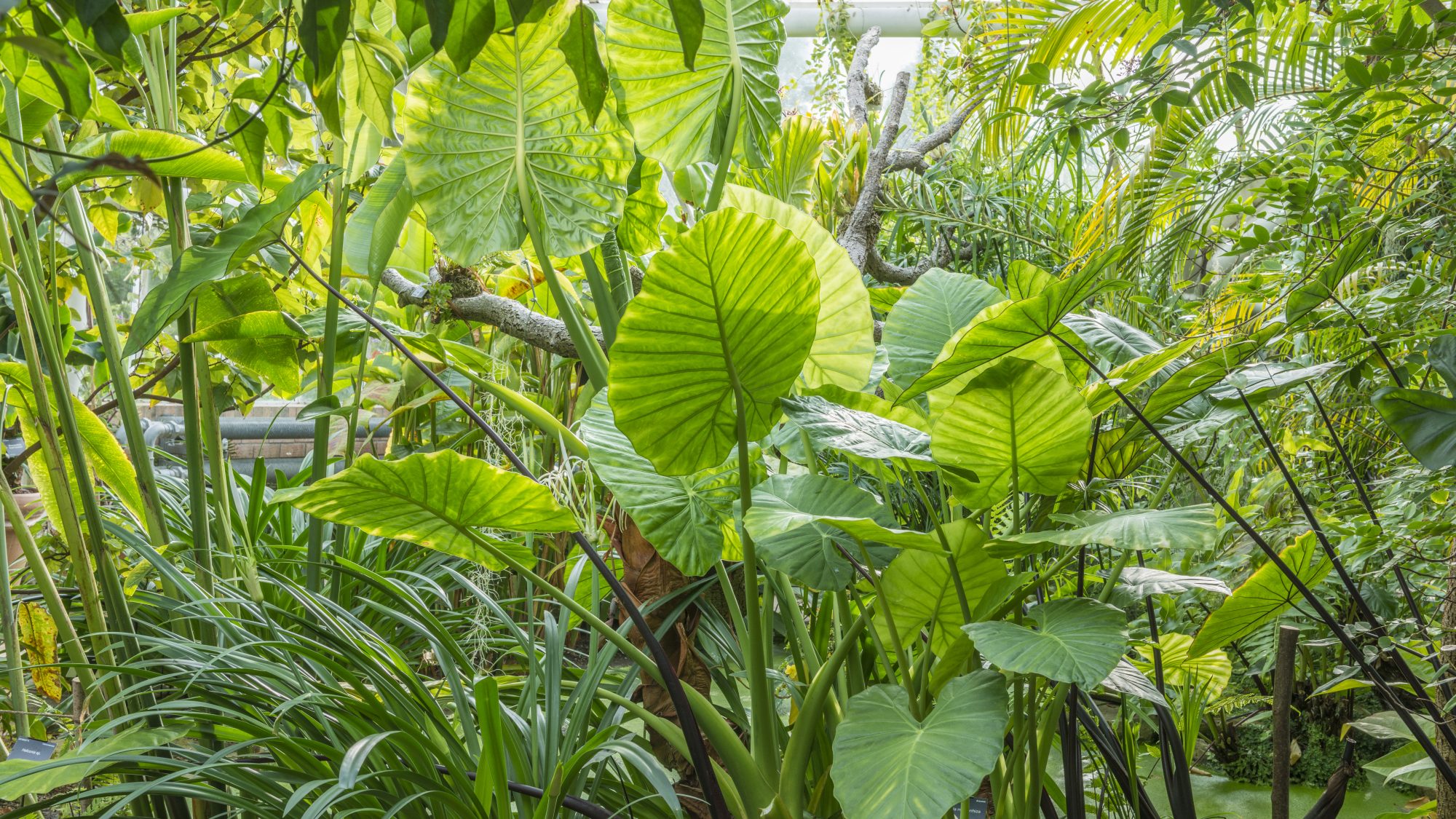
I have always had a love of plants and gardens, but despite developing a familiarity with common garden plants as a youngster nothing prepared me for my first encounters with tropical plants in the Palm House at Kew, and the Tropical Houses here at Cambridge University Botanic Garden. The plants were completely alien to me with enormous leaves and exotic blooms, all growing in a warm and humid environment. The combination of plants and tropical atmosphere created an intimate environment. I was mesmerised by the lush foliage of plants such as the Asian taro (Colocasia esculenta), the Colombian black-gold philodendron (Philodendron melanochrysum) and cocoa (Theobroma cacao). Seeing such diverse, lush vegetation was mind blowing.

A bright green heart shaped leaf with a dark purple stork and leaf veins, with blurred leaves and plants in the background
Colocasia exculenta var. fontanesii (credit: Howard Rice). Click for information
A close-up of a dark brown leave with bright green veins.
Philodendron melanochrysum (credit: Howard Rice). Click for information

Where do tropical plants come from?

Originating from equatorial tropical rainforests of South America, Central America, Central Africa and south-east Asia, tropical plants have evolved to survive, and even thrive, in hot, humid conditions. Tropical rainforests are made up of distinct plant layers, with the highest one formed of slender-stemmed emergent trees which can reach 60m in height and tower above the rainforest. Beneath these sits a dense canopy of shorter trees to 40m high, and these create a rich habitat for wildlife, including insects, reptile, birds and mammals, but also block out light to cast dense shade across the rainforest floor. An understorey of emerging saplings grows in cooler, shady conditions, and here seedlings may grow to plug the canopy where gaps appear. The lowest layer is dark, and is formed from decaying roots and rotting plant matter which form a moisture retentive, humus-rich forest floor. Together these make a complex habitat containing an array of highly adapted plants.

A range of green tropical plants fill a glasshouse, with a pond and rocks in the centre.
The Tropics House at Cambridge University Botanic Garden (credit: Howard Rice). Click for information
Looking up to the roof of a glasshouse with green tropical plants either side reaching up to the roof of the glasshouse.
The Glasshouse Range at Cambridge University Botanic Garden (credit: Howard Rice). Click for information

What is a tropical plant?

Tropical plants have evolved to suit shady, hot, humid conditions, in which annual rainfall is high, and temperatures remain constant, usually between 26ºC and 29ºC. Plants show a range of adaptations to these conditions. The tallest, emergent trees have buttress roots to help stabilise them, and tree trunks have smooth bark which helps water flow freely to the roots. Waxy leaf surfaces and drip tips at the end of the leaf help channel water from the leaf surface to prevent diseases. Woody vines (lianas) clamber up through trees in search of light and produce leaves and flowers in the rainforest canopy. Epiphytic plants are those which grow on host plants without taking nutrients from them. They gather moisture and nutrients from the air, rain and debris high in the forest canopy.

A glasshouse at Cambridge University Botanic Garden on a sunny, blue sky day, filled with green plants with trees in the background and flowers in the foreground.
The Tropics House at Cambridge University Botanic Garden (credit: Howard Rice). Click for information
A tropical plant with large pointy leaves and tall thin stems.
Carludovica palmata (credit: Howard Rice). Click for information
A single orchid flower with curved yellow and red petals with green plants blurred int he background.
Monodora myristica orchid (credit: Howard Rice). Click for information

Which tropical plants do we grow at Cambridge University Botanic Garden?

Our tropical houses grow a host of plants to inspire and create a sense of wonder, though unfortunately many of these are not widely available. Perhaps the plant that most captivates visitors is the jade vine (Strongylodon macrobotrys), an endangered bat-pollinated liana from the rainforests of the Philippines, which can reach 20m in height and produces pendent flower clusters along a central stem (racemes) of brilliant, turquoise, claw-like flowers – a real showstopper.

But other plants are equally beguiling. The titan arum (Amorphophallus titanium) is native to the rainforests of Sumatra. Unfortunately for us it is shy to bloom, but the flower has a ruffle-like collar and an erect thick spike of tiny flowers (spadix) – up to 3m tall, and emits a foul aroma to attract pollinating beetles. Perhaps not a horticultural beauty in everyone’s eyes, but certainly a botanical curiosity.

The calabash nutmeg (Monodora myristica) is an impressive tree bearing speckled, lantern-like flowers in the canopy of our tropical houses. Carludovica palmata (Panama hat palm) produces large, pleated fan-like leaves and is used to produce Panama hats. Members of the ginger family are quite at home in the tropical conditions here, and include the beehive ginger (Zingiber spectabile) and the torch ginger (Ettlingeria elatior). Several Dutchman’s pipes scramble through hosts such as the Darth Vader plant (Aristolochia salvadorensis) and Aristolochia arborea. Epiphytic plants can also be found here. Orchids in a range of sizes and colours from rainforests across the globe nestle amongst the limbs and foliage of host plants, and Spanish moss (Tillandsia usneoides) from the Americas hangs curtain-like from tree branches.

These are just a few of my favourites to whet the appetite, but there is always something to capture the imagination in these verdant houses.


Turquoise hanging flowers made up of claw like flowers on a central stem amongst trees, palms and tropical plants.
Jade vine at Cambridge University Botanic Garden (credit: Howard Rice). Click for information
A plant made up of a tall yellow centre, erect amongst a purple and green ruffle-like collar at its base. It sits in a pot in the middle of ferns, trees and other green plants.
Amorphophallus titanum (credit: Howard Rice). Click for information
Yellow cone-like plants with tall green stems, with blurred green storks and leaves in the background.
Zingiber spectabile (credit: Howard Rice). Click for information
A pointed plant with pink-red leaves getting bigger towards the base of the stem, with a white trim.
Etlingeria elatior (credit: Howard Rice). Click for information
Aristolochia salvadorensis (credit: Howard Rice). Click for information
Aristolochia arborea (credit: Howard Rice). Click for information
Orchids at Cambridge University Botanic Garden (credit: Howard Rice). Click for information
Orchid Paphiopedilum gratrixianum (credit: Howard Rice). Click for information
An orchid flower with white, yellow and pink petals amongst a blurred blue background.
Cymbidium 'Vieux Rose Dell Park' (credit: Howard Rice). Click for information

How to grow tropical plants at home

The chances are that if you grow house plants you may already be growing a tropical plant. Asian moth orchids (Phalaenopsis species) are readily available and adorn many kitchen windowsill, often with little horticultural attention, though a plethora of other tropical orchids are available.

Popular tropical house plants include the herringbone plant (Maranta leuconeura), the money tree (Pachira aquatica) and the fiddle leaf fig (Ficus lyrata). While we are fortunate at the Botanic Garden to be able to dedicate space solely to the cultivation of tropical plants most of us don’t have that luxury in our homes. There is still scope to grow elephant’s ears (Alocasia species and cultivars), parlour palm (Chamaedorea elegans) and many other tropical plants if you provide the right conditions. All will thrive in indirect light, a minimum temperature of 15ºC, a humid environment provided through regular misting, well-drained compost, and watering when the compost surface dries out.

Many will also relish spending a summer in your garden, providing that they aren’t in bright sunlight which may scorch them. If you’re encouraged to start growing tropical plants at home now is a good time to dip your feet with garden centres and on-line retailers offering a host of plants to choose from. What better way to create a horticultural talking point in your home or garden than adding a touch of the exotic such as a banana (Musa basjoo) or stag’s horn fern (Platycerium bifurcatum) to your plant collection. And of course, many of these will grow outdoors in pots or in the garden over summer, but will require either the protection of a greenhouse or conservatory in winter, or wrapping with fleece or hessian over winter if left outside.

If you fancy bringing a touch of the exotic to your own patch there are many plants you can try at home. Some of the hardier bananas, such as Musa basjoo, are good candidates. These coupled with plants such as pineapple lilies (Eucomis pole-evansii), and arum lily (Zantedeschia aethiopica) in a warm, sunny corner will bring a hint of warm, tropical climes to your summer garden. But if you’re really not inclined to test out your green fingers, and a trip to the tropics is off the radar, a visit to the tropical houses at the Botanic Garden will provide a taste of the tropics.

Two large, light green leaves with thick stems and veins.
Alocasia macrorrhiza (credit: Howard Rice). Click for information
A yellow orchid flower with red-brown stripes. One pointed petal shots up while four others curl to the sides.
Orchid bulbophyllum lobbii (credit: Howard Rice). Click for information
Looking up the trunk of a tree, which has a spikey-leaved plant growing up and wrapping itself around its bark, surrounded by a canopy of trees.
Strophocactus wittii (credit: Howard Rice). Click for information
Banana tree, Musa basjoo. Click for information
A white lilly flower with a tall yellow spadix, surrounded by green leaves.
Zantedeschia aethiopica 'Crowborough', arum lily (credit: Howard Rice). Click for information

Gardening jobs for August

  • Take a moment to relax and enjoy your garden.
  • Harvest crops such as lettuce, carrots, beetroot, beans, sweetcorn and onions.
  • Continue deadheading flowers in your borders and pots to encourage more flowers.
  • Take softwood cuttings of plants such as lavender, pelargoniums and penstemons.
  • Pinch the growing tips out of tomato plants in the garden to encourage fruit to develop and ripen.
  • Keep pots well-watered.

You may also be interested in

Right plant, right place: Gardening for a changing climate

Right plant, right place: Gardening for a changing climate

Head of Horticulture, Sally Pettit, shares advice on how to make gardens that thrive in a changing climate.
Bringing native plants into the garden for wildlife and colour

Bringing native plants into the garden for wildlife and colour

Head of Horticulture, Sally Pettit, highlights native plants and how you can incorporate them into your garden.
Spring in the trees: Flowers, catkins and pollination

Spring in the trees: Flowers, catkins and pollination

Head of Horticulture, Sally Petitt, highlights the remarkable flowering and pollination of trees.
University of Cambridge Museums and Botanic Garden

Social

  • Follow us on YouTube
  • Follow us on Twitter
  • Follow us on Instagram
  • Follow us on Facebook
  • Follow us on Threads
  • Follow us on LinkedIn

© 2026 Cambridge University Botanic Garden

  • Privacy policy
  • Contact us