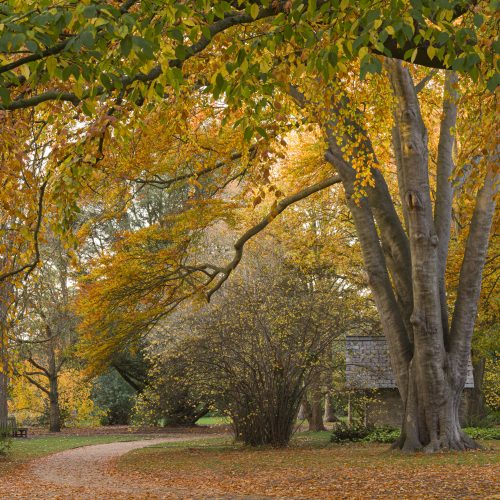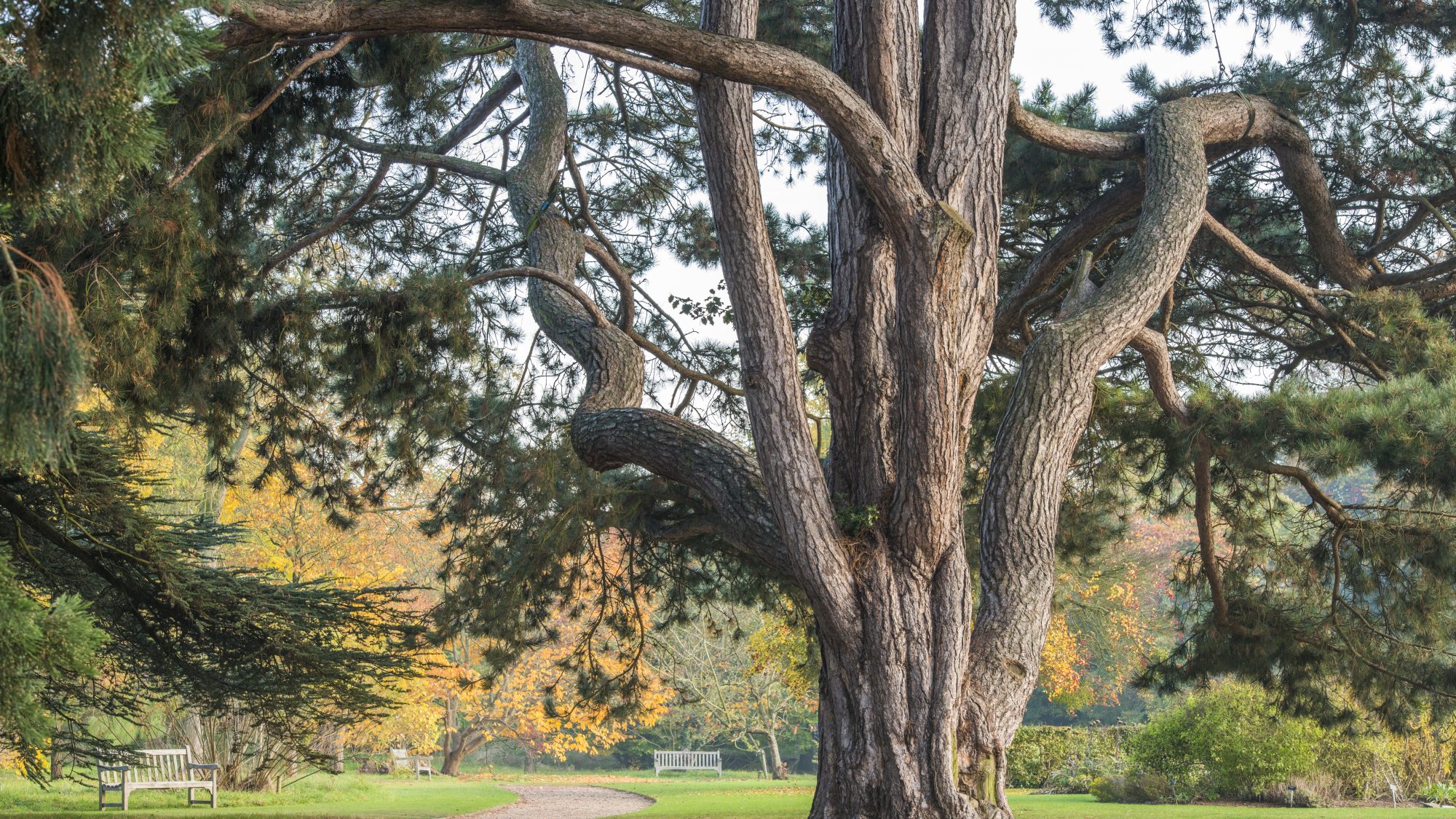
It’s hard to imagine a world without trees. Many of us will have a favourite tree, whether it is a flowering cherry we daily pass on the street, or a tree that brings back happy memories of a relative or a favourite holiday.
Here at the Botanic Garden, we have approximately 2,000 individual trees ranging from saplings of only two or three years of age to mighty giants of over 170 years, such as our giant redwoods (Sequoiadendron giganteum).
The value of trees though reaches far beyond their aesthetic or sentimental value. Trees also have economic value, with oaks being highly valued for their use in construction, while others produce edible fruits, such as the native hazel, or cobnut, (Corylus avellana), and exotic species like the fig (Ficus carica) and orange (Cirtus x sinensis). Beyond this though, trees add so much more value to our lives and the environment. They absorb carbon dioxide which helps slow global warming; they stabilise soils; they improve water quality and reduce the risk of flooding; they provide shade and act as coolants, which is particularly valuable in cities; they reduce noise; and they support biodiversity – it is estimated that a single oak tree can support as many as 2,300 species of insects, birds, mammals, fungi, lichens, liverworts and mosses. There really are many reasons for planting a tree, and as the old adage says “The best time to plant a tree was 20 years ago, and the second best time is now”.


There is a wide variety of trees available for different situations. For containers, varieties of Japanese maples (Acer palmatum) can be grown in acidic compost and will reward with intensely coloured foliage, while the cherry Prunus ‘Kojo-no-mai’ has zig-zagging stems and delicate blossom.
If you have a little more space and are looking for a tree under 5m tall, a snowy mespilus (Amelanchier lamarckii) makes a great specimen, as does the paperbark maple (Acer griseum) with its cinnamon-coloured, peeling bark. With more space you might try a crab apple such as Malus ‘Everest’ whose striking blossom is followed by yellow-orange fruits, or perhaps the spring-flowering Cornus kousa var. chinensis, both of which grow to 6-8m.
If space is no problem and you can accommodate a specimen which will grow to over 12m in height, you might choose an English oak (Quercus robur) to encourage biodiversity, or perhaps the Indian bean tree (Catalpa bignonioides) whose showy flowers cover the broad canopy in summer.


The autumn months provide the perfect window for planting trees, while the soil is still warm and autumn and winter rainfall will encourage root establishment, but avoid planting into waterlogged or frozen ground. Pot-grown trees can be planted at any time of the year but will require more frequent watering immediately after planting.
To encourage tree establishment, take care at the planting stage. Water the tree well before planting; dig a hole no deeper than the root ball, but twice as wide; place your tree in the hole so that the upper roots are level with the surrounding ground; backfill the hole; firm the soil to remove air pockets around the roots; water again to help firm the tree in place and ensure that roots are in contact with the soil. Once planted, check soil moisture levels frequently and water once the soil has dried out. If there are dry summers in the first three years, you may need to apply 4 – 6 watering cans of water weekly.
If you have limited space, you may choose to grow a container specimen. For this choose a container with plenty of drainage holes which is approximately twice the width of the root ball of your chosen tree; add compost to the pot and place your tree in top of this, making sure that the upper roots are level with the ultimate compost level, allowing space to apply water, and then follow the steps above. Remember though that pot-grown plants dry out more quickly than those in the ground, and will benefit from the replacement of the top layer of compost each spring, or the addition of a liquid fertiliser at regular intervals to ensure the tree has access to nutrients for healthy growth.
Remember to match your tree to the conditions in your garden. There is no point in planting a moisture-loving weeping willow (Salix babylonica) in a well-drained, gritty site, or in squeezing a cedar of Lebanon (Cedrus libani) into a four-metre square front garden – neither will survive to maturity. But if you choose carefully, and nurture well, you will be able to enjoy your efforts for many years, whilst also knowing that planting your tree has wider-reaching benefits.


Gardening jobs for November
- Plant a tree.
- Mulch borders with compost, wood chips or gravel to preserve moisture and suppress weeds.
- Plant tulips bulbs now that the weather has cooled and the rick of tulip blight has subsided.
- Plant winter such as pansies, cyclamen and polyanthus.
- Sow sweet pea seeds indoors and grow them on in a cold, frost-free place as soon as they germinate.